
The Agni Suktam, the very first hymn of the Rigveda. This is also considered as the first mantra of the humanity. It is not merely a collection of ancient verses but a foundational pillar of cosmic and spiritual wisdom. Here Agni is not just a God, but the cosmic principles of all gross and subtler levels of energy fields, and consciousness.
This Suktam is dedicated to Agni, the Vedic principle of Fire, it is the primordial invocation that opens humanity’s oldest scripture, symbolizing the dawn of consciousness and the quest for divine knowledge. In the Sri Amit Ray 114 Chakra System, the activation of inner fire (Agni Kriyas) is essential for dissolving energetic blockages, purifying the nadis, and attaining spiritual clarity. The Agni Suktam functions as a powerful vibrational instrument for this awakening. The Agni Suktam is directly associated with the Sankalpa Chakra, Setu Chakra, Sakshi Chakra, Guru Chakra, and the Nirvana Chakra.
This sacred hymn channels the divine energies of transformation, illumination, and sacred connection. Each verse pulses with the life-giving force of cosmic fire, empowering the seeker to dispel inner darkness, ignite wisdom, and establish a living bridge between the earthly and the divine. The recitation of the Agni Suktam is traditionally believed to bestow clarity, vitality, purity, and the radiant awakening that arises through the grace of the Sacred Fire. This is a mantra not just for chanting but for deep contemplation.
Introduction | What is | Origins | Lyrics | English Lyrics | Meanings | Significance | Meditation | Benefits | FAQs | Agni Chakras
Introduction: The Primordial Invocation
The Agni Suktam is the inaugural hymn of the Rigveda, the most ancient extant scripture known to humanity. As the very first composition (Rigveda 1.1) in this colossal spiritual treasury, it holds a position of unparalleled importance. Dedicated to Agni, the God of Fire, this hymn is far more than a poetic homage; it is a foundational metaphysical blueprint that establishes the core Vedic principles of yajna (sacrifice), rita (cosmic order), and the perpetual dialogue between the human and the divine.
In the Sri Amit Ray 114 Chakra System, or the advance Ray 256 Chakar System the kindling of the inner fire, or Agni, is paramount for cleansing nadis (energy channels), dissolving chakra blockages, and achieving the luminous state of higher consciousness. The Agni Suktam serves as a potent vibrational key for this inner ignition and awaking the Agni Chakras. Each verse acts as a sacred catalyst, channeling the divine energy of transformation, purification, and illumination. Regular recitation is believed to bestow clarity, burn away karmic impurities, awaken latent wisdom, and establish a living bridge (setu) to the celestial realms, bringing forth blessings of vitality, prosperity, and profound inner awakening.
What Is Agni Suktam?
Agni Suktam, also known as Agni Sukta, is the opening hymn of the Rigveda (Mandala 1, Hymn 1). It is addressed to Agni, the Vedic deity of fire, illumination, transformation, and divine mediation. The Rigveda deliberately begins with Agni, establishing fire as the bridge between human aspiration and cosmic intelligence.
In Vedic thought, Agni is not merely physical fire but the principle of consciousness, aspiration, and sacred order (ṛta).
Origins and Historical Context
The Agni Suktam originates from the first mandala (book) of the Rigveda. Its seer (rishi) is traditionally acknowledged as Madhuchchhandas Vaishvamitra. The term “Suktam” means “well-spoken” or “beautifully recited hymn,” indicating its perfected poetic and spiritual form. Its placement as the very first hymn is deeply intentional and symbolic.
Agni in the Vedic pantheon is a multivalent deity. He is:
- The Physical Fire: The literal flame on the altar, the domestic hearth, and the forest fire.
- The Inner Fire: The fire of digestion (jatharagni), metabolism, willpower (tejas), and intelligence (medha).
- The Cosmic Fire: The all-pervading energy of transformation in the universe, the light of consciousness itself, present in lightning and the sun.
This hymn positions Agni as the essential mediator—the divine priest (hotri) who carries the oblations and prayers of humans to the gods (devas). Without Agni, the ritual and, by extension, the connection to the cosmos, is incomplete. Sage Madhuchchhandas, through profound revelation, encoded this universal truth into a rhythmic, potent mantra. The Agni Suktam thus becomes the first step in the spiritual journey, teaching that recognizing and properly invoking the sacred principle of Fire is the prerequisite for all higher knowledge and attainment.
Inner Significances: Igniting the Inner Altar
The Agni Suktam serves as a metaphysical blueprint for inner transformation. Each verse is not just an external invocation but a call to awaken and purify the latent fires within the human system. This esoteric layer transforms the hymn into a tool for burning away impurities (malas) and illuminating consciousness. Below are the symbolic interpretations of key aspects of Agni invoked in the hymn:
- Agni as the Divine Priest (Hotri) → The Inner Guide: Agni is called the perfect priest, the hotri, who performs the sacrifice flawlessly. This represents the purified human intellect and will, which can orchestrate the offering of sensory impressions, thoughts, and ego into the fire of awareness, leading to liberation.
- Agni as the Messenger (Duta) → The Bridge of Consciousness: As the messenger, Agni connects the earthly and divine realms. This symbolizes the activated Sushumna nadi or the antahkarana (inner instrument), which becomes the channel for spiritual aspiration to reach higher states of consciousness.
- Agni as the All-Knowing (Jatavedas) → The Witnessing Awareness: The name Jatavedas means “he who knows all creations.” This signifies the pure, witnessing consciousness (sakshi) within us that is aware of all thoughts, actions, and their origins, leading to true self-knowledge.
- Agni as the Consumer of Offerings → The Fire of Renunciation: Agni consumes the sacrificial offerings. This represents the inner fire of vairagya (dispassion) and tyaga (renunciation) that burns up attachments, desires, and the sense of doership, freeing the soul.
- Agni as Light (Rochana) → The Illuminator of Darkness: The hymn repeatedly praises Agni’s radiant light that dispels darkness. This is the light of wisdom (jnana) that destroys the darkness of ignorance (avidya), the root cause of suffering and bondage.
Through these invocations, the Agni Suktam facilitates a profound inner yajna (sacrifice), where the limited ego-self is offered into the fire of supreme knowledge, leading to unity with the divine.
First Mantra of Humanity
The First Mantra of Humanity. Agni is explored here not merely as fire, but as the cosmic principle of Purohita (the one placed in front), the guardian of Eternal Law (Rta), and the divine consciousness that transforms matter into spirit.
Inner Significances: The Spiritual Alchemy of Fire
Beyond its ritual use, the Agni Suktam is a profound manual for inner transformation. Each epithet of Agni corresponds to a stage or facet of spiritual awakening. The hymn guides the seeker in conducting an internal yajna where the limited ego is offered as fuel to the flame of awareness.
| Symbolic Aspect of Agni | Inner Significance | Related Spiritual Goal |
|---|---|---|
| Hotri (The Invoking Priest) | The purified intellect and focused will that orchestrates the inner sacrifice of senses and thoughts. Activates the Sankalpa Shakti Chakra. | Mind Control, Concentration (Dharana) |
| Duta (The Messenger) | The activation of 7 main Agni Nadis, 3 Guru Nadis, and the Sushumna nadi or Antahkarana (inner instrument) that bridges human aspiration with divine grace. Activate the Setu Agni Chakra. | Meditative Connection, Channeling Higher Wisdom |
| Jatavedas (He Who Knows All Creations) | The pure Witnessing Consciousness (Saakshi) within, which is aware of all thoughts and actions without judgment. Activates the Sakshi Chakra. | Self-Realization (Atma-Jnana), Detachment |
| Purohita (The Foremost Priest) | The primal, guiding light of the soul (atman) or the Guru-principle that leads from within. Activates the Guru Chakra. | Inner Guidance, Discernment (Viveka) |
| Rochana (The Illuminator) | The light of wisdom (Jnana) that dispels the darkness of ignorance (Avidya), the root cause of suffering. Activates the Nirvana Chakra. | Dispelling Illusion, Gaining Clarity |
Through consistent practice, chanting the Agni Suktam facilitates this inner alchemy. The “wealth” it brings is not merely material but the supreme treasure of enlightenment. The “victory” it secures is the triumph over internal enemies like desire (kama), anger (krodha), and greed (lobha).
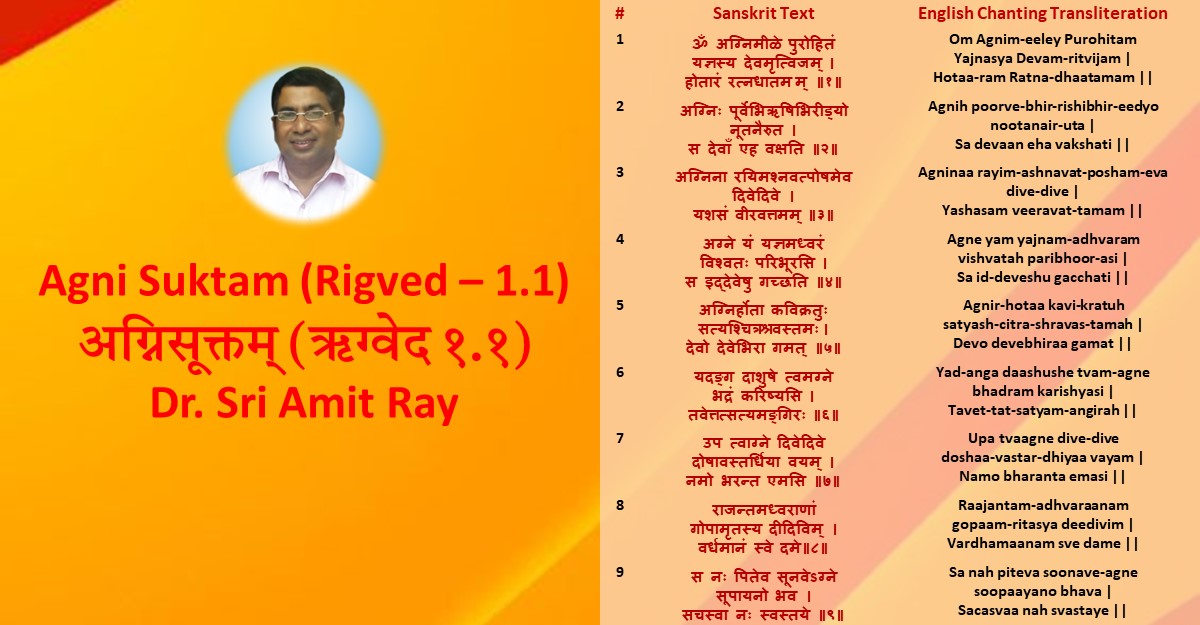
Agni Suktam Lyrics
ॐ अग्निमीळे पुरोहितं यज्ञस्य देवमृत्विजम् । होतारं रत्नधातमम् ॥१॥
अग्निः पूर्वेभिर्ऋषिभिरीड्यो नूतनैरुत । स देवाँ एह वक्षति ॥२॥
अग्निना रयिमश्नवत्पोषमेव दिवेदिवे । यशसं वीरवत्तमम् ॥३॥
अग्ने यं यज्ञमध्वरं विश्वतः परिभूरसि । स इद्देवेषु गच्छति ॥४॥
अग्निर्होता कविक्रतुः सत्यश्चित्रश्रवस्तमः । देवो देवेभिरा गमत् ॥५॥
यदङ्ग दाशुषे त्वमग्ने भद्रं करिष्यसि । तवेत्तत्सत्यमङ्गिरः ॥६॥
उप त्वाग्ने दिवेदिवे दोषावस्तर्धिया वयम् । नमो भरन्त एमसि ॥७॥
राजन्तमध्वराणां गोपामृतस्य दीदिविम् । वर्धमानं स्वे दमे ॥८॥
स नः पितेव सूनवेऽग्ने सूपायनो भव । सचस्वा नः स्वस्तये ॥९॥
Complete Text with Sanskrit, Transliteration, and Meaning
Below is the complete Agni Suktam (Rigveda 1.1), presented with the original Sanskrit in Devanagari script, standard IAST transliteration for accurate pronunciation, and a detailed explanation of the meaning and symbolism for each verse.
Verse 1: Rigveda 1.1.1 – The Invocation
संस्कृत: अग्निमीळे पुरोहितं यज्ञस्य देवमृत्विजम् । होतारं रत्नधातमम् ॥
IAST: agnimīḷe purohitaṃ yajñasya devamṛtvijam | hotāraṃ ratnadhātamam ||
Meaning & Significance: “I lovingly praise Agni, the supreme priest, the divine minister of the sacrifice, the invoker, the greatest bestower of treasure.” This opening verse establishes all of Agni’s primary roles. Purohita means “placed foremost,” signifying his prime importance. Ratna (treasure) signifies both worldly prosperity and spiritual wealth like wisdom and liberation.
Verse 2: Rigveda 1.1.2 – The Eternal Link
संस्कृत: अग्निः पूर्वेभिर्ऋषिभिरीड्यो नूतनैरुत । स देवाँ एह वक्षति ॥
IAST: agniḥ pūrvebhirṛṣibhirīḍyo nūtanairuta | sa devām̐ eha vakṣati ||
Meaning & Significance: “Agni, worthy of worship by the ancient seers and by the new, will bring the gods here.” This verse affirms the timeless, eternal relevance of Agni. He is the constant, unchanging principle that connects every generation of seekers to the divine. Eha vakṣati (“will bring here”) promises the tangible presence of divine energies through correct invocation.
Verse 3: Rigveda 1.1.3 – The Bestower of Abundance
संस्कृत: अग्निना रयिमाश्नवत् पोषमेव दिवेदिवे । यशसं वीरवत्तमम् ॥
IAST: agninā rayimāśnavat poṣameva divedive | yaśasaṃ vīravattamam ||
Meaning & Significance: “Through Agni, one obtains wealth, nourishment day after day, and glory most rich in heroes.” This verse outlines the holistic benefits. Rayi is flowing abundance; Poṣa is sustained growth and nourishment; Yaśas is radiant fame. A society with “heroes” (vīra) signifies vitality and righteousness, all flowing from alignment with Agni’s principle.
Verse 4: Rigveda 1.1.4 – The Protector
संस्कृत: अग्ने यं यज्ञमध्वरं विश्वतः परिभूरसि । स इद्देवेषु गच्छति ॥
IAST: agne yaṃ yajñamadhvaraṃ viśvataḥ paribhūrasi | sa iddeveṣu gacchati ||
Meaning & Significance: “O Agni, you who encompass the sacrifice on all sides, that offering truly reaches the gods.” Agni is visualized as the protective, all-encompassing force around the ritual. This signifies that when an action (yajna) is undertaken with complete surrender and within the sacred enclosure of awareness (Agni), it becomes perfect and acceptable to higher laws.
Verse 5: Rigveda 1.1.5 – The Truthful Boon-Giver
संस्कृत: अग्निर्होता कविक्रतुः सत्यश्चित्रश्रवस्तमः । देवो देवेभिरा गमत् ॥५॥
IAST: Agnir-Hotaa Kavikratuh Satyash-Citrashravastamah | Devo Devebhir-Aa Gamat ||5||
Meaning & Significance: Agni is the Hota, the Invoker, who is Far-Sighted with wisdom and is uniquely Famed for sticking to the Truth. Who understands the true motive behind the Yagya and give fruits accordingly. May that cosmic principle (Agni) come here with the other Gods and make the Yagya successful.
Verse 6: Rigveda 1.1.6 – Agni the Truthful one and Boon-Giver
संस्कृत: यदङ्ग दाशुषे त्वमग्ने भद्रं करिष्यसि । तवेत तत् सत्यमङ्गिरः ॥
IAST: yadaṅga dāśuṣe tvamagne bhadraṃ kariṣyasi | tavet tat satyam-aṅgiraḥ ||
Meaning & Significance: “O Agni Angiras, whatever blessing you will create for the worshipper, that indeed of yours is true.” This is a verse of supreme faith. Addressing Agni as Angiras connects him to the primordial sage family associated with fire and mystical knowledge. It declares that Agni’s grace is the embodiment of truth itself—the only assured fulfillment for a sincere devotee. Also, Angiras is a name for Agni, meaning ‘luminous one’ or ‘messenger of truth’.
Verse 7: Rigveda 1.1.7 – The Approach in Darkness
संस्कृत: उप त्वाग्ने दिवेदिवे दोषावस्तर्धिया वयम् । नमो भरन्त एमसि ॥
IAST: upa tvāgne divedive doṣāvastardhiyā vayam | namo bharanta emasi ||
Meaning & Significance: “To you, O Agni, day by day, O dispeller of darkness, we come with contemplative thought, bearing homage.” This is a personal prayer of approach. Doṣāvastar means “one whose covering is darkness” — Agni who removes the veil of ignorance. The devotee comes with dhiyā (reverent thought) and namah (salutation), modeling the ideal attitude of humility and focused intent.
Verse 9: Rigveda 1.1.8 – The Sovereign Guardian
संस्कृत: राजन्तमध्वराणां गोपां रतस्य दीदिविम् । वर्धमानं स्वे दमे ॥
IAST: rājantamadhvarāṇāṃ gopāṃ ratasya dīdivim | vardhamānaṃ sve dame ||
Meaning & Significance: “To you, the shining ruler of rites, the guardian of Cosmic Order (Rta), the radiant one, ever increasing in your own home.” This verse celebrates Agni’s sovereignty and integrity. He is the protector (gopam) of Rta, the natural law. His “own home” (sve dame) is both the physical altar and, esoterically, the heart of the devotee, where he grows when tended with devotion.
Verse 9: Rigveda 1.1.9 – The Accessible Divine Father
संस्कृत: स नः पितेव सूनवे अग्ने सूपायनो भव । सचस्वा नः स्वस्तये ॥
IAST: sa naḥ piteva sūnave agne sūpāyano bhava | sacasvā naḥ svastaye ||
Meaning & Significance: “O Agni, be easily accessible to us as a father is to his son. Abide with us for our well-being.” The hymn concludes with an intimate, heartfelt appeal. Moving from cosmic symbolism to personal relationship, it seeks Agni’s benevolent, paternal presence for enduring peace, welfare (svastaye), and protection. It affirms that the ultimate cosmic power is also a compassionate, personal guardian.
Agni Suktam English Lyrics (Rigveda 1.1)
Sanskrit (IAST)
oṃ agnimīḻe purohitaṃ yajñasya devamṛtvijam । hotāraṃ ratnadhātamam ॥1॥
agniḥ pūrvebhirṛṣibhirīḍyo nūtanairuta । sa devā~ eha vakṣati ॥2॥
agninā rayimaśnavatpoṣameva divedive । yaśasaṃ vīravattamam ॥3॥
agne yaṃ yajñamadhvaraṃ viśvataḥ paribhūrasi । sa iddeveṣu gacchati ॥4॥
agnirhotā kavikratuḥ satyaścitraśravastamaḥ । devo devebhirā gamat ॥5॥
yadaṅga dāśuṣe tvamagne bhadraṃ kariṣyasi । tavettatsatyamaṅgiraḥ ॥6॥
upa tvāgne divedive doṣāvastardhiyā vayam । namo bharanta emasi ॥7॥
rājantamadhvarāṇāṃ gopāmṛtasya dīdivim । vardhamānaṃ sve dame ॥8॥
sa naḥ piteva sūnave’gne sūpāyano bhava । sacasvā naḥ svastaye ॥9॥
Benefits of Chanting Agni Suktam
Regular and devoted recitation of the Agni Suktam, with understanding and intent, is believed to bestow a wide array of benefits, harmonizing the individual with the fundamental transformative power of the universe.
1. Ignition of Willpower & Clarity
Dispels mental fog, lethargy (tamas), and indecision. It sharpens the intellect (buddhi) and fuels determination (sankalpa shakti), essential for overcoming procrastination and self-doubt.
2. Holistic Purification
Acts as a spiritual purifier (pavitrikarana). It burns away negative mental impressions (samskaras), purifies the emotional body, and can cleanse the physical and subtle environment of stagnant or negative energies.
3. Removal of Obstacles (Vighna Nashana)
As the foundational hymn, it is a powerful prayer for sanctifying the start of any new endeavor—be it spiritual, educational, or professional. It removes blockages stemming from past karma or present ignorance.
4. Enhanced Vitality & Health
Stimulates the inner digestive fire (jatharagni), promoting robust metabolism and assimilation of nutrients. A balanced Agni is considered the root of physical health (arogya) in Ayurveda.
5. Gateway to Higher Wisdom
Establishes a direct link with the principle of consciousness. It prepares and clarifies the mind (chitta shuddhi) for receiving deeper insights, making it an excellent preparatory practice for meditation and Vedic study.
6. Righteous Abundance & Success
Attracts prosperity (dhana) and success (sampatti) that are in alignment with dharma. It ensures that achievements are stable, sustainable, and contribute to overall well-being, not just personal gain.
How to Chant: Procedure and Ideal Timings
| Step | Procedure | Purpose / Significance |
|---|---|---|
| 1. Preparation (Shuddhi) | Take a bath or wash hands, face, and feet. Sit facing East or North on a clean mat (wool, grass, or cotton). | Physical purity symbolizes inner readiness and respect for the sacred practice. |
| 2. Intention (Sankalpa) | Calm the mind, take a few deep breaths. Silently or softly state your sincere purpose for chanting (e.g., for knowledge, purification, peace). | Focuses the mind and directs the energy of the mantra towards a specific, positive outcome. |
| 3. Invocation | Begin with a simple prayer to Lord Ganesha for obstacle removal and to your Guru/Ishta Devata. | Ensures the practice is blessed and free from inner and outer hindrances. |
| 4. Chanting (Japa/Patha) | Chant the full Agni Suktam clearly, paying attention to pronunciation. Use a mala (rosary) if doing multiple repetitions (108 is traditional). | The sound vibrations create a specific energy field that purifies the chanter and the environment. |
| 5. Contemplation (Manana) | After chanting, sit quietly for a few minutes, meditating on the meaning of the verses, especially the qualities of Agni. | Allows the vibrational impact to settle and integrates the intellectual understanding with experience. |
| 6. Conclusion (Purnahuti) | Offer a mental offering of gratitude to Agni and the Rishis. Pray for the well-being of all. | Completes the inner yajna (sacrifice) with a sense of universal goodwill, expanding the benefits. |
Ideal Timings (Muhurta):
- Brahma Muhurta: (See the Brahma Muhurta Time at your Location) The pre-dawn period (approx. 1.5 hours before sunrise). This is the most sattvic (pure) time, ideal for spiritual practices as the mind is calm and the atmosphere is charged with potential.
- Sunrise: The junction of night and day, symbolizing illumination. Chanting as the sun rises aligns with Agni’s manifestation as light.
- Noon: When the sun (a form of Agni) is at its peak, representing maximum energy and power.
- During any Homa/Fire Ritual: Chanting it while making offerings into a physical fire greatly amplifies its potency.
Comparative Analysis: Agni Suktam and Other Key Vedic Hymns
| Aspect | Agni Suktam (Rigveda 1.1) | Surya Suktam (Rigveda 10.85, etc.) | Purusha Suktam (Rigveda 10.90) | Shri Suktam (Apocryphal to Rigveda) |
|---|---|---|---|---|
| Primary Deity | Agni (Immanent, Transformative Fire) | Surya (Solar Disc, Source of Light & Life) | Purusha (Cosmic Being, Source of All) | Shri Lakshmi (Goddess of Abundance) |
| Core Theme | Invocation, Connection, Sacrificial Bridge | Illumination, Health, Vitality, Sovereignty | Cosmic Creation, Interconnectedness, Sacrifice | Both Material & Spiritual Prosperity, Grace |
| Primary Purpose | To begin, to connect, to transform, to purify. | To energize, to heal, to gain clarity and power. | To understand origin, nature, and one’s place in the cosmos. | To attract auspiciousness, wealth, and holistic prosperity. |
| Symbolic Level | Inner Will, Digestive Fire, Mental Light | Soul (Atman), Higher Consciousness, Prana | The Unified Field, The Collective Whole | Inner Contentment, Value, Growth |
| Best Used For | Starting new ventures, daily purification, kindling inner drive, ritual initiation. | Improving health, gaining confidence, dispelling darkness of mind, leadership. | Spiritual expansion, understanding unity, rituals for peace and harmony. | Removing poverty consciousness, attracting opportunities, achieving stability. |
Key Meditation Pillars in the Suktam
| Principle | Meaning in the Suktam | Application to Humanity |
|---|---|---|
| Purohita | Placed in front / High Priest | Prioritizing light and wisdom in every action and decision. |
| Ratnadhatamam | Bestower of treasures | Seeking both material prosperity and the “jewels” of spiritual realization. |
| Gopam Rtasya | Guardian of Eternal Law | Aligning human life and society with the natural, cosmic order (Rta). |
| Vardhamanam | Ever-increasing | The commitment to constant spiritual, intellectual, and moral growth. |
Agni Chakras
In the Sri Amit Ray tradition, Agni chakras are defined as functional regulatory nodes rather than localized anatomical centers and are designated using a consistent Sanskrit compound nomenclature to ensure semantic precision, interdisciplinary coherence, and terminological stability. Within this framework, the Agni Suktam is specifically mapped to five principal Agni-regulatory domains—Saṅkalpa–Agni Chakra, Setu–Pravartaka–Agni Chakra, Sākṣya–Agni Chakra, Guru or Niyojaka–Agni Chakra (Guru principle), and Prakāśa–Agni Chakra (Nirvāṇa principle)—which together constitute an integrated system of intention, transmission, witnessing, guidance, and illumination.
Frequently Asked Questions (FAQs)
1. Why is the Agni Suktam placed as the very first hymn in the Rigveda?
Agni represents the foundational principle of transformation and connection. In Vedic thought, no spiritual or worldly endeavor can succeed without first igniting the sacred fire—both externally on the altar and internally as the fire of aspiration, discipline, and purity. Placing it first symbolizes that the entire journey of knowledge (Veda) begins with this essential act of kindling.
2. Can I chant the Agni Suktam without performing a physical fire ritual (homa)?
Yes, absolutely. While chanting during a homa is immensely powerful and recommended when possible, the primary and most important “fire altar” is the heart and mind of the sincere chanter. The focused repetition of the verses with correct pronunciation, understanding, and devotion (bhava) is itself a potent mental homa (manasika yajna) that yields all the spiritual benefits. The physical ritual is an external aid to internalize this process.
3. What is the best time to chant the Agni Suktam?
The most auspicious and powerful times are during Brahma Muhurta (the pre-dawn period, about 1.5 hours before sunrise) and at sunrise. These times are dominated by sattva guna (purity and clarity), and the element of fire in nature is naturally ascending. Chanting at noon (when solar Agni is peak) is also beneficial. However, it can be chanted with sincerity at any time, preferably on an empty or light stomach.
4. What is the difference between Agni Suktam and other fire-related hymns like the Surya Suktam?
Agni Suktam invokes fire as the immanent, transformative force within creation—the sacrificial flame, the digestive fire, the fire of speech and mind. Agni is the interiorized, accessible form of divine energy. Surya Suktam invokes the Sun as the transcendent, cosmic source of all light, life, and spiritual sovereignty—the external, grand center of our system. Surya is the source; Agni is his representative and active force on Earth and within beings. They are complementary aspects of the same radiant principle.
5. How does the Agni Suktam relate to modern life and psychological well-being?
It is profoundly relevant. It teaches the art of sacred transformation: how to properly “digest” life experiences (both good and bad) without forming mental or emotional “toxins” (resentment, trauma, greed). It shows how to convert the raw fire of our passions and anger into the focused fire of willpower and determination. In a world of distraction, it is a tool to rekindle clarity, purpose, and the inner light of discernment, helping to burn away anxiety, fear, and the inertia that prevents growth.
Conclusion and Free Resources
The Agni Suktam is the eternal spark that lights the path of the seeker. By studying, contemplating, and integrating this primordial hymn into one’s daily sadhana (practice), one aligns with the very force that governs transformation in the universe. It is an invitation to move from the darkness of unawareness to the luminous state of conscious living, from a fragmented existence to a connected, purposeful life in harmony with cosmic law (Rta).
Explore Related Vedic Hymns:
- Shri Suktam – For attracting auspiciousness and holistic abundance.
- Purusha Suktam – For understanding cosmic unity and the nature of existence.
- Durga Argala Stotram – For divine protection and overcoming inner enemies.
- Durga Suktam – That burns away avidya (ignorance) and bad krams (that bind the soul).
May the light of Agni illuminate your path, purify your heart, and lead you to the supreme truth. 🙏