The Dashavatara refers to the ten principal incarnations of Lord Vishnu, the cosmic preserver in the Hindu Trinity (Trimurti). Vishnu descends whenever adharma (cosmic disorder) rises beyond tolerance, restoring balance through wisdom, power, compassion, or divine strategy. These avatars span vast cosmic cycles (yugas) and collectively symbolize the evolution of life, consciousness, ethics, and spiritual realization—from primal aquatic existence to enlightened human awareness and future renewal.
Introduction to Dashavatara
The Bhagavad Gita (4.7–8) declares: “Yadā yadā hi dharmasya glānir bhavati bhārata… sambhavāmi yuge yuge.” (“Whenever righteousness declines and unrighteousness rises, I manifest Myself age after age.”)
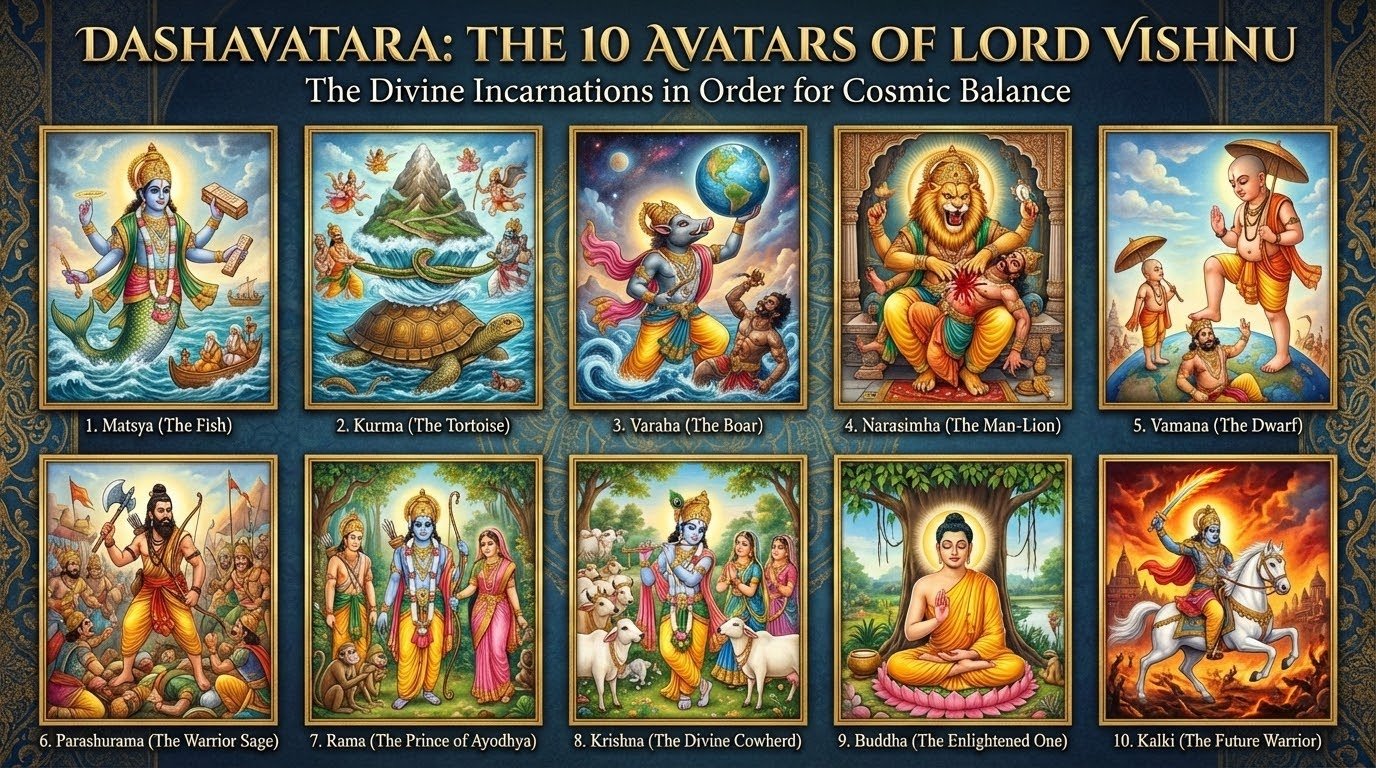
The Dashavatara—Matsya, Kurma, Varaha, Narasimha, Vamana, Parashurama, Rama, Krishna, Buddha (or Balarama), and Kalki—are not random mythic tales. Each incarnation responds precisely to the psychological, social, and cosmic conditions of its age, offering humanity a living blueprint of dharma appropriate to that era.
Together, they reflect not only mythology and theology but also a profound symbolic parallel to biological evolution, moral development, and spiritual ascent.
Sri Amit Ray 114-Chakra Mapping Table for Dashavatara
| Avatar | Evolutionary Stage | Basic 7 Chakra Domain | Ray 114-Chakra Primary Focus Areas | Inner Meaning & Consciousness Function |
|---|---|---|---|---|
| Matsya | Aquatic / Survival Life | Pre-Muladhara & Earth Chakras | Lower Survival Chakras (1–12) | Preservation of life-force, ancestral memory, subconscious intelligence, survival awareness during chaos |
| Kurma | Amphibian / Stabilization | Muladhara–Sacral Bridge | Stability & Nervous System Chakras (13–24) | Grounding, endurance, emotional regulation, ability to sustain transformation without collapse |
| Varaha | Terrestrial Mammalian Strength | Sacral–Solar Plexus | Embodiment & Vitality Chakras (25–36) | Reclaiming embodied consciousness, ecological balance, vitality, Earth–body coherence |
| Narasimha | Instinct + Intelligence Fusion | Heart Protection Field | Courage & Trauma-Release Chakras (37–48) | Fear dissolution, devotion-activated protection, collapse of ego-based dominance patterns |
| Vamana | Ego Formation & Transcendence | Solar Plexus–Heart Axis | Humility & Expansion Chakras (49–60) | Ego compression, surrender, expansion beyond identity, ethical power regulation |
| Parashurama | Warrior Ethics | Will & Boundary Chakras | Justice & Discipline Chakras (61–72) | Righteous action, boundary setting, elimination of inner corruption and misuse of power |
| Rama | Social & Moral Order | Heart–Throat Harmony | Relational & Dharma Chakras (73–84) | Ethical coherence, trust, duty, emotional integrity, ideal leadership consciousness |
| Krishna | Integrated Divine Intelligence | Higher Heart & Ajna | Joy, Wisdom & Play Chakras (85–96) | Bliss-intelligence, karma yoga mastery, alignment of action, love, and insight |
| Buddha | Awakened Witness Consciousness | Ajna–Crown Bridge | Mindfulness & Quantum Attention Chakras (97–108) | Non-attachment, compassion, cessation of suffering, neuroplastic awakening through awareness |
| Kalki | Collective & Planetary Awakening | Above Crown / Transpersonal Field | Collective Coherence Chakras (109–114), and AI Consciousness | Systemic purification, truth-based civilization reset, planetary and collective AI consciousness |
1. Matsya Avatar (The Fish)
Story: At the end of a cosmic cycle, a devastating pralaya (flood) threatened to annihilate life and sacred knowledge. King Manu encountered a tiny fish asking for protection. As Manu nurtured it, the fish grew miraculously large, revealing itself as Vishnu. Matsya warned Manu of the coming deluge and instructed him to build a boat, carrying seeds of life, sages, animals, and the Vedas. When chaos engulfed the universe, Matsya towed the ark through the cosmic waters, ensuring continuity of creation.
Deeper Significance: Matsya represents the earliest stage of life—aquatic existence—and the divine safeguarding of knowledge. It teaches foresight, humility, and trust in cosmic intelligence. Spiritually, it signifies that wisdom survives even when civilizations collapse.
FAQ – Matsya Avatar
- Why did Vishnu appear as a fish? To align with the earliest life form and rescue knowledge during total dissolution.
- Who is Manu? Manu is the progenitor of humanity, similar to a cosmic ancestor.
2. Kurma Avatar (The Tortoise)
Story: To retrieve the lost amrita (nectar of immortality), devas and asuras churned the cosmic ocean using Mount Mandara as a rod. However, the mountain began to sink. Vishnu incarnated as Kurma, bearing the mountain on His massive shell, stabilizing the churning. From this effort emerged divine treasures—Lakshmi, Kalpavriksha, Airavata, and finally amrita.
Deeper Significance: Kurma symbolizes endurance, balance, and inner stillness. Like the tortoise withdrawing into its shell, it teaches yogic restraint and grounded perseverance amid chaos.
FAQ – Kurma Avatar
- Why was Kurma necessary? Without stability, even noble efforts collapse.
- What does Samudra Manthan symbolize? The churning of human consciousness to extract higher wisdom.
3. Varaha Avatar (The Boar)
Story: The demon Hiranyaksha dragged Earth into the cosmic abyss. Vishnu emerged as Varaha, plunging into primordial waters. After a titanic battle lasting eons, Varaha lifted Bhudevi gently upon His tusks, restoring her to her rightful orbit.
Deeper Significance: Varaha signifies environmental protection, ecological responsibility, and divine intervention to rescue the planet itself.
FAQ – Varaha Avatar
- Why a boar? The boar symbolizes primal strength and earth-connected vitality.
- Is this an environmental allegory? Yes, it highlights Earth preservation as sacred duty.
4. Narasimha Avatar (The Half-Man, Half-Lion)
Story: Hiranyakashipu obtained a boon making him seemingly immortal. His son Prahlada remained devoted to Vishnu despite severe torture. At twilight, Vishnu burst from a pillar as Narasimha—neither man nor beast—and destroyed the tyrant on His lap, restoring dharma.
Deeper Significance: Narasimha embodies divine ferocity tempered by devotion. Faith becomes invincible when aligned with truth.
FAQ – Narasimha Avatar
- Why such a terrifying form? To dismantle arrogance that hides behind logic and power.
- What is the lesson of Prahlada? Pure devotion transcends fear.
5. Vamana Avatar (The Dwarf)
Story: King Bali ruled the three worlds. Vishnu incarnated as Vamana, requesting only three steps of land. He expanded cosmically, covering heaven and earth in two strides. Bali offered his head for the third, earning liberation.
Deeper Significance: Vamana teaches humility, surrender, and the illusory nature of power.
FAQ – Vamana Avatar
- Why did Vishnu humble Bali? To curb ego, not devotion.
- Was Bali evil? No, he was virtuous but overly ambitious.
6. Parashurama Avatar
Story: Parashurama, a Brahmin by birth and warrior by destiny, eliminated corrupt rulers who abused power. He restored dharma through fierce justice.
Deeper Significance: He represents righteous anger and the necessity of moral boundaries.
FAQ – Parashurama Avatar
- Why did he fight repeatedly? To purge systemic corruption.
- Is violence justified? Only when protecting dharma.
7. Rama Avatar
Story: Rama’s life in the Ramayana exemplifies ideal kingship, marital fidelity, sacrifice, and justice. His victory over Ravana restored cosmic harmony.
Deeper Significance: Rama embodies ethical perfection—Maryada Purushottama.
FAQ – Rama Avatar
- Why is Rama called ideal? He upheld dharma even at personal cost.
- What is Ram Rajya? A society governed by justice and compassion.
8. Krishna Avatar
Story: Krishna combined divine playfulness with supreme wisdom. He guided Arjuna through existential crisis via the Bhagavad Gita and orchestrated the defeat of tyranny.
Deeper Significance: Krishna represents divine love, strategy, and spiritual intelligence.
FAQ – Krishna Avatar
- Why is Krishna playful? To show divinity includes joy.
- What is Krishna’s core teaching? Selfless action with devotion.
9. Buddha Avatar
Story: As Buddha, Vishnu emphasized compassion, mindfulness, and liberation from suffering, steering humanity away from ritualistic excess.
Deeper Significance: Buddha represents inner awakening and non-violence.
FAQ – Buddha Avatar
- Why Buddha as an avatar? To restore compassion.
- Is this accepted universally? Some traditions replace him with Balarama.
10. Kalki Avatar
Story: Kalki will appear at Kali Yuga’s end, destroying corruption and re-establishing Satya Yuga.
Deeper Significance: Kalki symbolizes hope, renewal, and ultimate justice.
FAQ – Kalki Avatar
- When will Kalki appear? At the end of Kali Yuga.
- Is Kalki symbolic? Both literal and metaphysical renewal.
The Overall Significance of Dashavatara
The Dashavatara is a cosmic map of evolution—biological, ethical, and spiritual. It teaches humanity that divine intelligence adapts, evolves, and intervenes whenever balance is threatened.
Frequently Asked Questions (FAQ)
What is Dashavatara?
The Dashavatara refers to the ten principal incarnations of Lord Vishnu, who descends to Earth across different cosmic ages to restore dharma and maintain universal balance.
Why does Lord Vishnu take avatars?
According to the Bhagavad Gita, Vishnu incarnates whenever righteousness declines and chaos rises, to protect the virtuous and destroy evil.
Why did Vishnu appear as Matsya (the Fish)?
Matsya represents the earliest aquatic life form and was manifested to save humanity, sages, and the Vedas during the great cosmic flood (pralaya).
What does the Kurma Avatar symbolize?
Kurma symbolizes stability, patience, and inner balance, supporting Mount Mandara during the churning of the cosmic ocean.
Why did Vishnu incarnate as Varaha?
Varaha appeared to rescue the Earth (Bhudevi) from the demon Hiranyaksha, symbolizing environmental protection and cosmic restoration.
Why is Narasimha neither man nor animal?
Narasimha’s form transcended logical categories to bypass Hiranyakashipu’s boon and demonstrate that divine justice is beyond human constraints.
What is the spiritual lesson of the Vamana Avatar?
Vamana teaches humility and surrender, showing that ego and excessive ambition must yield to divine order.
Why did Parashurama eliminate corrupt kings?
Parashurama restored balance by removing rulers who abused power, emphasizing that authority without righteousness leads to destruction.
Why is Lord Rama called Maryada Purushottama?
Rama is considered the ideal human because he upheld dharma, duty, honor, and justice even at great personal sacrifice.
What is the core teaching of Lord Krishna?
Krishna teaches Karma Yoga—selfless action with devotion—along with wisdom, love, and strategic intelligence through the Bhagavad Gita.
Is Buddha really an avatar of Vishnu?
In many Vaishnava traditions, Buddha is considered an avatar who promoted compassion and non-violence; some traditions replace him with Balarama.
What is the purpose of the Kalki Avatar?
Kalki is the future avatar who will appear at the end of Kali Yuga to destroy corruption and re-establish Satya Yuga.
Are the Dashavatara connected to evolution?
Many scholars observe a symbolic parallel between the avatars and biological evolution—from aquatic life to fully awakened human consciousness.
What is the overall message of the Dashavatara?
The Dashavatara teaches that divine intelligence adapts to time, culture, and consciousness to protect life, ethics, and spiritual growth.
Relatead Posts
-
 Shattila Ekadashi 2026: Complete Fasting Rules, Spiritual Benefits & Scientific Significance
-
Utpanna Ekadashi Fasting 2026 Timings, Benefits: Complete Guide
-
From the Womb to Wisdom: Narada’s Teachings to Prahlada
-
Ekadashi Calendar 2026: All Dates, Timings, Fasting Rules & Benefits
-
The 16 Names of Lord Vishnu: Invoking Divine Grace in Every Moment
-
Sri Amit Ray’s 36 Hours Ekadashi Fasting Protocol: A Mathematical Model