
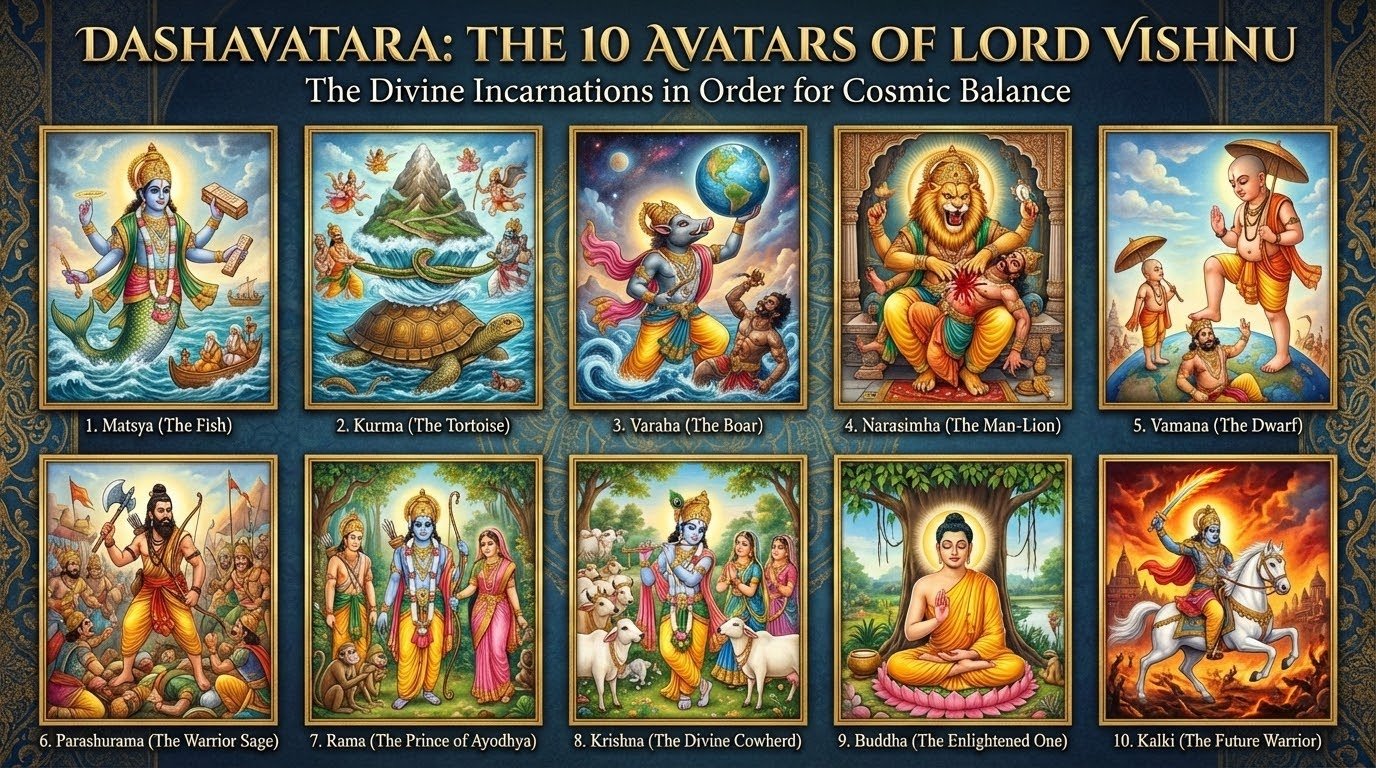
The Dashavatara refers to the ten principal incarnations of Lord Vishnu, the cosmic preserver in the Hindu Trinity (Trimurti). Vishnu descends whenever adharma (cosmic disorder) rises beyond tolerance, restoring balance through wisdom, power, compassion, or divine strategy. These avatars span vast cosmic cycles (yugas) and collectively symbolize the evolution of life, consciousness, ethics, and spiritual realization—from primal aquatic existence to enlightened human awareness and future renewal.
Introduction to Dashavatara
The Bhagavad Gita (4.7–8) declares: “Yadā yadā hi dharmasya glānir bhavati bhārata… sambhavāmi yuge yuge.” ("Whenever righteousness declines and unrighteousness rises, I manifest Myself age after age.")
The Dashavatara—Matsya, Kurma, Varaha, Narasimha, Vamana, Parashurama, Rama, Krishna, Buddha (or Balarama), and Kalki—are not random mythic tales. Each incarnation responds precisely to the psychological, social, and cosmic conditions of its age, offering humanity a living blueprint of dharma appropriate to that era.
Together, they reflect not only mythology and theology but also a profound symbolic parallel to biological evolution, moral development, and spiritual ascent.