AI Agents and Robots in Peacekeeping Force and Social Care: Compassionate AI Technologies

    Abstract

    A Peacekeeping Compassionate Robot is an autonomous or semi-autonomous robotic system engineered to support peacekeeping and conflict mitigation operations by combining advanced sensing, decision-making, and actuation capabilities with ethical, affective, and prosocial behaviors. Such robots are designed to interact safely and empathetically with humans, facilitating de-escalation, providing assistance in crisis situations, and promoting social cohesion. Their operation integrates multidisciplinary frameworks, including robotics, artificial intelligence, human–robot interaction, cognitive modeling, and moral reasoning, enabling them to respond adaptively to complex social environments while minimizing harm and fostering trust and cooperation.
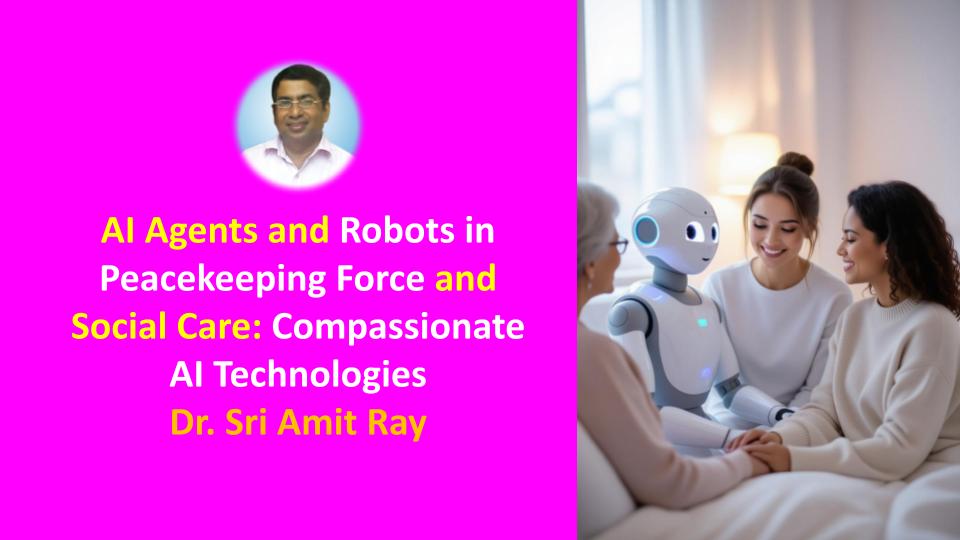
    This article examines the emerging role of AI agents and compassionate robots in peacekeeping operations and social care environments. It explores how advanced artificial intelligence, ethical decision-making frameworks, and human–robot interaction principles can be integrated to design systems that not only enhance operational efficiency but also promote empathy, trust, and social harmony.

    The article highlights the technological, ethical, and practical considerations in deploying such systems, including autonomous sensing, adaptive behavior modeling, conflict de-escalation, and human-centric care. By bridging the domains of robotics, AI, and social sciences, this work aims to provide a comprehensive framework for the development and responsible implementation of compassionate AI technologies in contexts that demand both safety and empathy.

    Introduction: A New Era of Compassionate AI

    The 21st century presents humanity with two pressing needs: the quest for peace in conflict-ridden zones and the demand for holistic social care in rapidly aging societies. Artificial intelligence (AI), once confined to data processing and automation, is now emerging as a transformative partner in meeting these challenges. At the heart of this revolution lies Compassionate AI—systems designed not only for efficiency but for empathy, ethics, and human dignity.

    A landmark innovation in this domain is the Ray Mother–Infant Inter-Brain Synchrony Algorithm (MI-Sync-AI), developed in the Sri Amit Ray Compassionate AI Lab. By modeling the profound neural synchrony between mothers and infants, MI-Sync-AI enables AI agents and robots to establish trust-based, empathetic interactions with humans. This breakthrough paves the way for AI to act as a peacekeeping force and as a social care ally, fostering harmony, well-being, and resilience worldwide.

    Read more ..

    Autophagy in AI: Destructive vs. Constructive

    There are two types of autophagias in AI: Destructive autophagy, and Constructive autophagy. Destructive autophagy refers to the process where AI systems, driven by self-learning mechanisms, start to consume their own error outputs, reinforcing errors, inaccuracies, and biases. Constructive autophagy represents a more controlled form of self-refinement, where AI systems refine their understanding and knowledge by compressing and distilling information. This article explores these two forms of AI autophagy in details.

    Self-healing AI refers to artificial intelligence systems that can detect, diagnose, and fix their own issues—without human intervention—just like how our body repairs itself through processes like autophagy. Autophagy AI is a fusion of biological intelligence and machine intelligence

    Autophagy, a cellular process that plays a critical role in maintaining the health and functionality of living cells, offers a compelling analogy for artificial intelligence (AI). In biological systems, autophagy refers to the process by which cells break down damaged or malfunctioning components and recycle them into useful building blocks, essentially ‘self-cleaning’ to preserve their overall health and efficiency.

    However, when AI systems, and AI agents are allowed to engage in a self-reflective learning process without careful regulation, they can enter cycles of self-improvement that, much like cellular autophagy, can lead to either self-preservation or self-destruction.

    Read more ..

    Five Steps to Building AI Agents with Higher Vision and Values

    Building reliable AI agents with higher values and safety is a challenge. It requires balancing advanced technological innovation with rigorous testing, transparency, and accountability. This article explores five key steps and the top ten ethical principles for developing reliable AI agents with higher values.

    Developing AI agents is not merely a technological endeavor; it is an artistic process of harmonizing purpose, integrating human values, intelligence, and adaptability. At our Compassionate AI Lab, the deeper purpose of innovation is to bring clarity, harmony, compassion, and higher values to life. Future AI agents are envisioned not just as tools but as catalysts for transforming society toward greater compassion, care, and better society.

    This article explores into the top ten ethical principles and five essential steps for creating an AI agent, blending technical innovation with a vision of enlightened progress. 

    The vision for future AI agents is not merely one of technological advancement but one of societal evolution, where compassion and intelligence collaborates to create a harmonious and enlightened world.

    Read more ..

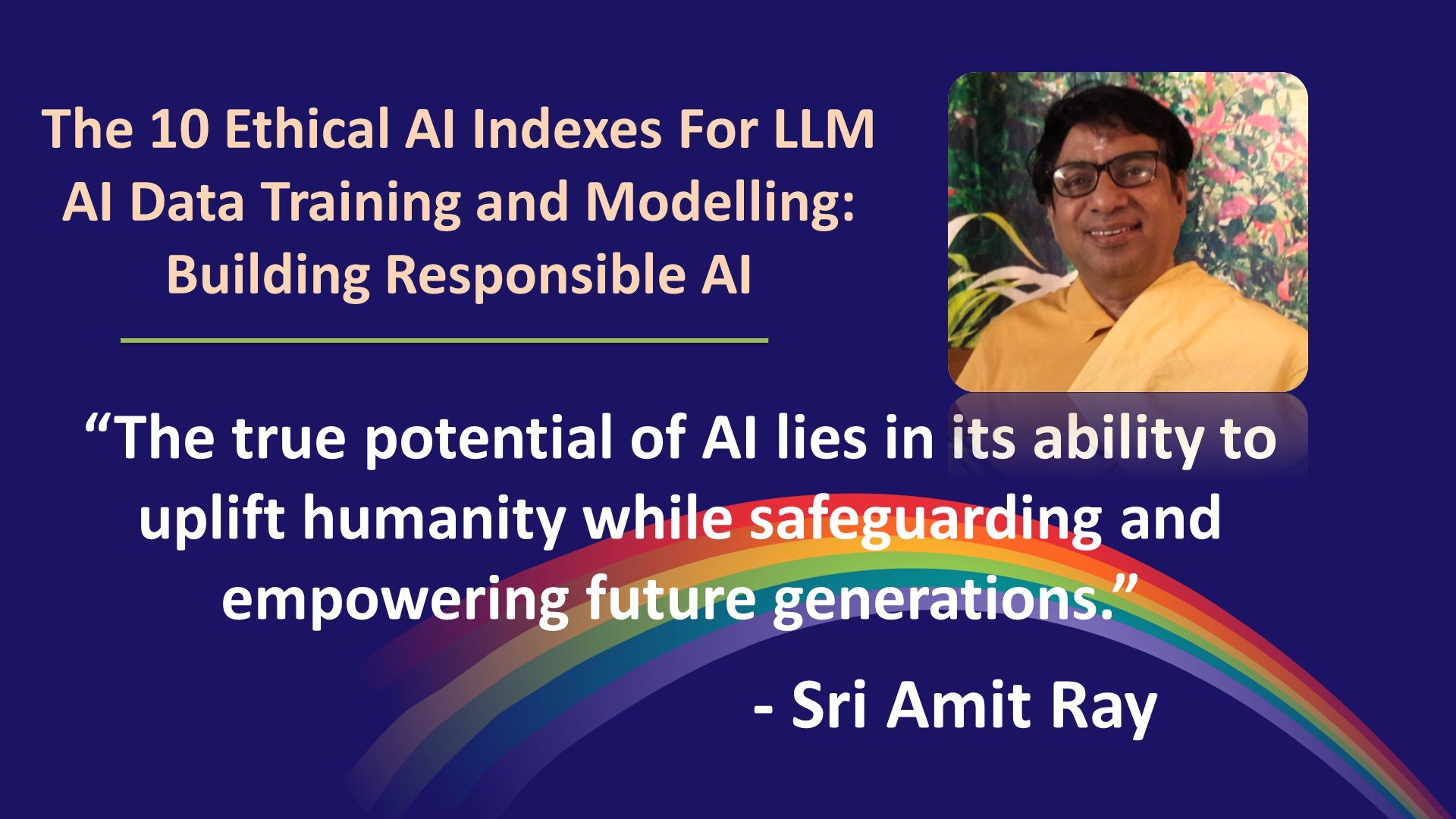
    The 10 Ethical AI Indexes for LLM Data Training and Responsible AI

    In this article, we present an exploration of ten indispensable ethical AI indexes that are paramount for the responsible AI development and deployment of Large Language Models (LLMs) through the intricate processes of data training and modeling.

    Ethical AI

    Within our compassionate AI Lab, we have diligently worked to create a series of AI indexes and measurement criteria with the objective of safeguarding the interests of future generations and empowering humanity. The names of the ten ethical AI indexes are as follows:

      1. AI Cage Index
      2. AI Traps Detection Index
      3. Bias Detection and Mitigation Index
      4. AI Hostility Data Training Index
      5. Data Source Diversity Index
      6. Data Collection Practices Index
      7. Transparency in Data Usage Index
      8. Ethical Data Collection Practices Index
      9. Data Anonymization and De-identification Index
      10. Human Oversight and Review Index

    Read more ..


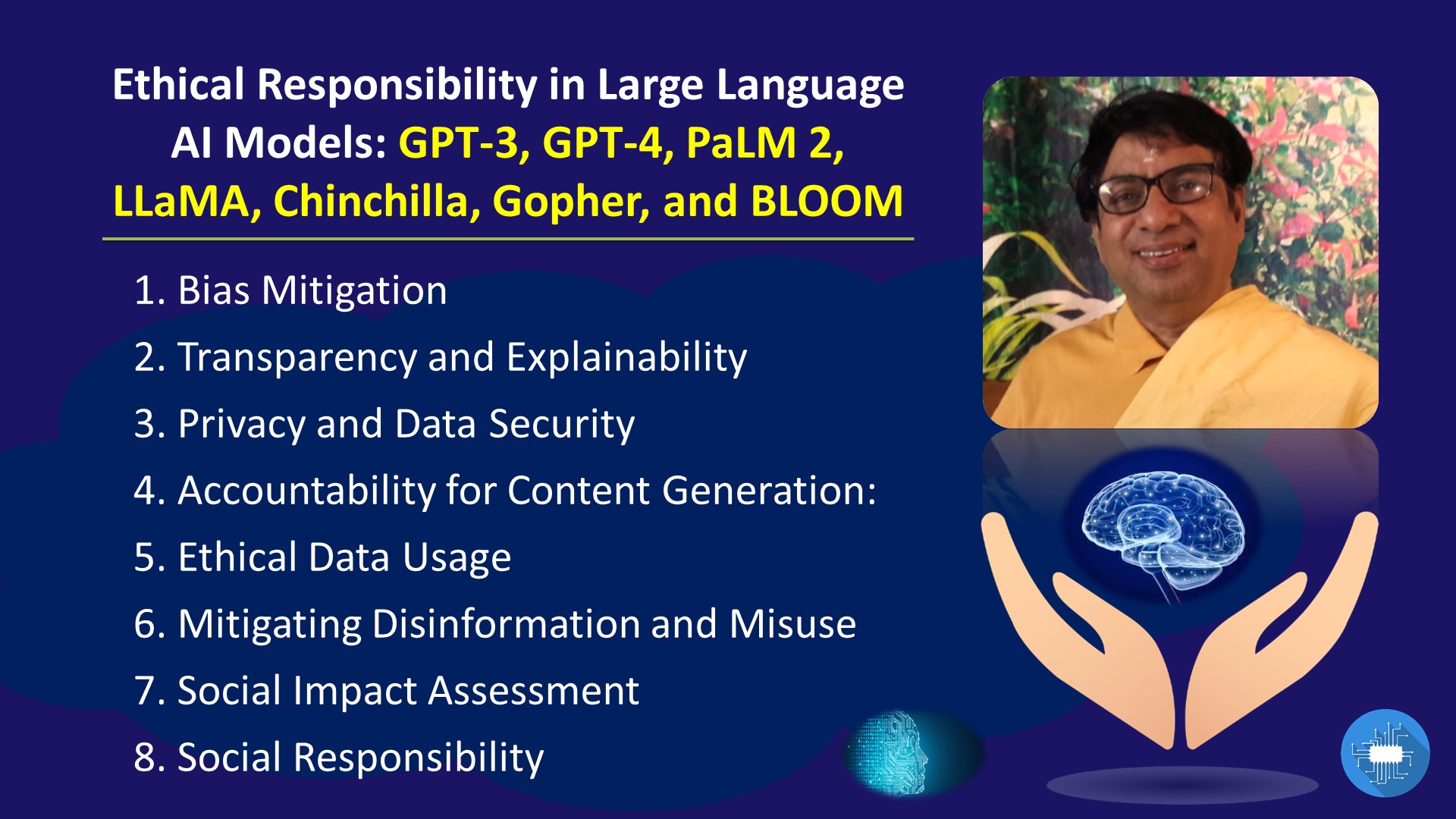
    Ethical Responsibilities in Large Language AI Models: GPT-3, GPT-4, PaLM 2, LLaMA, Chinchilla, Gopher, and BLOOM

    Large-language AI models like GPT-3, GPT-4, PaLM 2, LLaMA, Chinchilla, Gopher, and BLOOM have changed the field of artificial intelligence in a big way. However, ethical considerations are the biggest challenge for large-language AI models. These models are very good at generating language and have a huge amount of promise to serve humanity. But with a lot of power comes a lot of responsibility, and it's important to look into the social issues that come up when making and using these cutting-edge language models.

    Ethical Responsibility in Large Language AI Models

    Ethical Responsibility in Large Language AI Models

    In this article, we explore the ethical considerations surrounding large language AI models, specifically focusing on notable models like GPT-3, GPT-4, PaLM 2, LLaMA, Chinchilla, Gopher, and BLOOM. If not carefully addressed now, the immense power and influence of these types of models can inadvertently promote biases and other chaos in the human society. 

    By critically examining the ethical implications of large language AI models, we aim to shed light on the importance of addressing these concerns proactively. These models possess the ability to generate vast amounts of text, which can significantly impact society and shape public opinion. However, if not appropriately managed, this power can amplify biases, reinforce stereotypes, and contribute to the spread of misinformation.

    Read more ..


Contact us | About us | Privacy Policy and Terms of Use |

Copyright ©AmitRay.com, 2010-2024, All rights reserved. Not to be reproduced.