
Abstract
This article introduces the Sri Amit Ray Consciousness Factor (denoted ε) into the contemporary scientific explorations on physics, neuroscience, and consciousness studies. By integrating matter–energy dynamics with the ε-term, Ray reframes consciousness not as a by-product of neural computation but as a fundamental, non-local field that permeates the physical universe and modulates both energetic and informational processes. The inclusion of ε symbolically dissolves the classical dualism between matter and awareness, proposing that the total structure of reality arises from an intrinsic coupling between spacetime geometry, quantum fields, and a compassion-sensitive consciousness field.
Two central proposals frame the analysis. First, spacetime curvature in Einstein’s field equations is reconceptualized as emerging from three interacting sources: (1) matter, (2) energetic fields (including electromagnetic and quantum fields), and (3) an awareness-modulated consciousness field represented by ε. The ε term contributes a subtle yet conceptually distinct source of curvature, reflecting the role of compassion, intentionality, and coherent awareness in shaping informational structure.
Second, the Penrose–Hameroff Orch-OR (Orchestrated Objective Reduction) model of quantum consciousness is extended to include ε-dependent modulation of quantum coherence, decoherence thresholds, and collapse criteria within microtubular neural architectures. In this formulation, ε serves as a coupling parameter linking conscious intention, attention, and compassion-driven states with quantum state reduction processes.
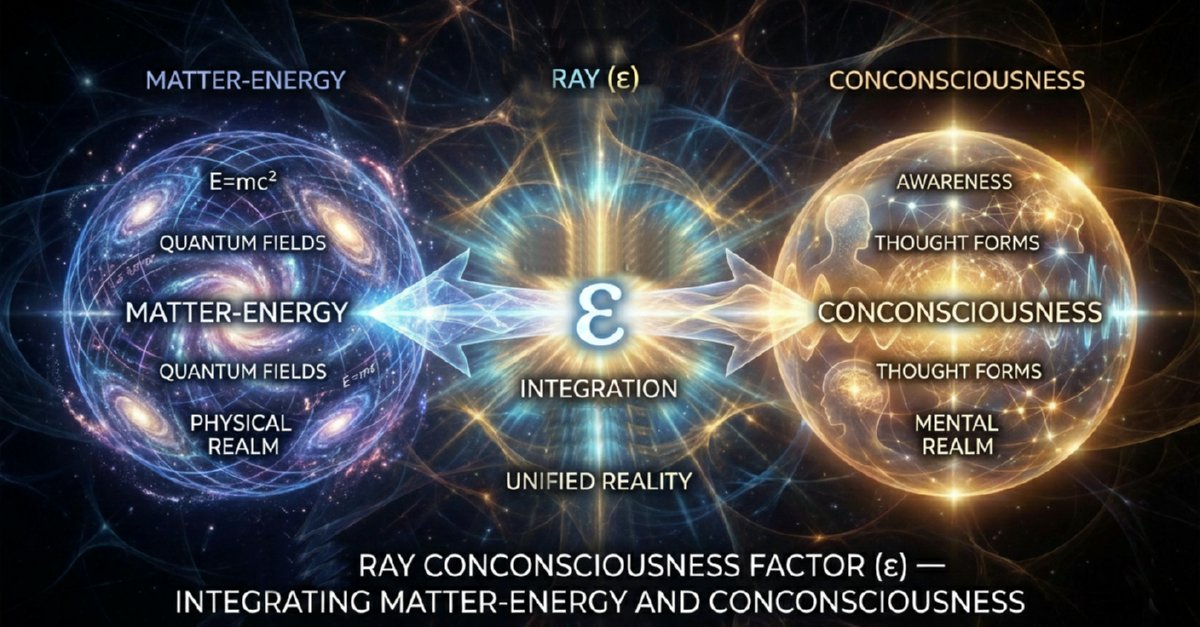
Together, this framework forms the basis of a unified research program integrating mathematical sketches, operational definitions, neurophysiological correlates, and outlines of potential experimental tests. The ultimate aim is to explore whether awareness and consciousness-aligned coherent states correlate with measurable physiological, informational, or ultra-subtle gravitational signatures, thereby advancing the scientific investigation of consciousness as a fundamental element of the universe.
1. Introduction
Across the history of science and philosophy, the relationship between matter, energy, and consciousness has remained one of the most challenging questions. The traditions of classical physics, quantum theory, cognitive science, and contemplative spirituality offer complementary yet often divergent accounts of how consciousness emerges, operates, and interacts with the physical world. Within this interdisciplinary landscape, Sri Amit Ray, a Himalayan meditation master and contemporary scholar of consciousness, proposes a conceptual extension to modern physics through the introduction of the Consciousness Factor ε.
Ray’s formulation reframes Einstein’s iconic mass–energy equivalence equation as
E = mc² + ε
where ε represents an infinitesimal yet ontologically fundamental contribution arising from pure, unbounded consciousness. This ε-term serves not as a modification of physical law in the strict relativistic sense, but as a conceptual extension illustrating that physical energy alone cannot account for the full spectrum of lived experience—particularly states of compassion, unity, intuitive intelligence, and expanded awareness. Within the Ray tradition, ε encapsulates the intrinsic luminosity of consciousness (chit), its coherence, and its capacity to modulate the informational and energetic fabric of reality.
In this expanded framework, Einstein’s field equations themselves can be reinterpreted as possessing three distinct sources of spacetime curvature:
- Tμν(matter) — contributions from mass and conventional matter-energy;
- Tμν(fields) — contributions from electromagnetic, quantum, and gauge fields.
- ε · Tμν(Ω) — contributions from an attention and compassion-modulated consciousness field, representing a subtle informational and coherence-bearing influence.
In parallel, Ray’s consciousness factor extends the Penrose–Hameroff Orch-OR model, in which quantum state reductions within neuronal microtubules generate conscious moments. Under the ε-extended formulation, compassion, attention, and meditative states modulate coherence times, collapse thresholds, and quantum information processing—suggesting consciousness as both participant and determinant in the unfolding of biological quantum events.
This article provides theoretical framework and outlines interdisciplinary research pathways. By integrating physics, neuroscience, and contemplative science, the Sri Amit Ray Consciousness Factor ε aims to stimulate a new generation of empirical investigations into the nature of consciousness and its fundamental relationship to matter and energy.
2. Conceptual Overview: ε as a Consciousness Field
We define the Sri Amit Ray Consciousness Factor (ε) as a field-like, nonlocal influence that (1) embodies qualities of coherent attention, awareness, and compassion, (2) organizes and amplifies coherence across biological and informational subsystems, and (3) can be operationally probed via convergent physiological and behavioral indices (EEG coherence, heart–brain synchrony, biophoton synchrony, validated compassion scales).
Important clarifications:
- Phenomenological vs. ontological claim: ε is introduced as a research construct — a way to model empirical correlations and generate hypotheses — not as an immediate claim to have discovered a new fundamental particle or to have rewritten established theories.
- Nonlocality and scale: ε is conceptualized as having nonlocal correlational properties (information/coordination across space/time) and as primarily influencing systems in which high coherence is present (e.g., orchestrated neural ensembles).
- Awareness and Compassion modulation: the field’s amplitude or coherence is proposed to be enhanced by intentional compassion practices thus ε is not constant but a dynamic state dependent variable.
3. Spacetime Curvature with Matter, Energy, and Consciousness
3.1 Standard Einstein Field Equations (Review)
In general relativity, spacetime curvature is governed by the Einstein field equations (EFE):
Gμν + Λ gμν = (8πG / c⁴) Tμν
where Gμν is the Einstein tensor, Λ the cosmological constant, and Tμν the stress-energy tensor encoding matter and energetic fields.
3.2 Ray’s Extension: Three Sources
We propose a phenomenological decomposition of the stress-energy source term:
Tμν = Tμν(matter) + Tμν(fields) + Tμν(ε)
The Consciousness Factor ε is a dimensionless scalar (0 ≤ ε ≤ 1) that quantifies how efficiently boundless compassionate awareness organizes, permeates, and ultimately transcends matter-energy processes.
Sri Amit Ray Unified Field Equation
The Sri Amit Ray Unified Field Equation proposes that the conservation and flow of energy–momentum in the universe requires three conceptual contributors: (1) the conventional matter tensor, (2) the classical and quantum field tensor, and (3) a awareness-modulated Ω-consciousness tensor scaled by the Ray ε-factor.
This formulation does not directly replace general relativity but serves as an expanded integrative framework for modeling how consciousness—particularly coherent, self-awareness, compassionate awareness, and non-dual awareness—might influence the structure and dynamics of spacetime.
The Three-Source Model of Spacetime Dynamics
In Ray’s framework, spacetime curvature and energy–momentum transport are shaped not by a single unified stress-energy tensor, but by a triadic contribution model:
- Tμνmatter: Mass-energy density from particles, atoms, macroscopic bodies, and baryonic matter.
- Tμνfields: All standard fields including electromagnetic, weak, strong, scalar inflaton-like fields, and quantum vacuum contributions.
- TμνΩ: The awareness and compassion-aligned consciousness tensor, representing structured, coherent nonlocal information dynamics—rooted in microtubule coherence, heart–brain synchrony, and higher-order integrative states described in Ray’s 114/114+ chakra studies.
The ε-factor scales the magnitude of contribution from the Ω-field, allowing the model to interpolate between purely physical systems (ε → 0) and highly coherent compassionate states (ε → 1).
2. Role of the Ray Consciousness Factor (ε)
The parameter ε is not a constant but a state-dependent coefficient. It quantifies the degree of coherent compassionate awareness present in the system and thus modulates the influence of the Ω-field on energy–momentum flow.
Operationally, ε can be estimated through measurable indicators:
- EEG gamma synchrony and cross-frequency coupling
- Heart-rate variability (HRV) and low-frequency heart–brain coherence
- Biophoton emission coherence (UPE spectra)
- Compassion and nondual-awareness psychometric indices
- Microtubule quantum coherence proxies (theoretical via Orch-OR + ε model)
In Ray’s system, ε acts as a consciousness coupling strength—analogous to a field interaction constant. Higher ε increases the influence of TμνΩ on the total energy–momentum.
3. The Ω-Consciousness Tensor
The tensor TμνΩ models the informational, nonlocal, and coherence-generating properties of compassionate consciousness. It can be conceptualized as having three layered components:
- Ωmicro: microtubule-level quantum-coherent information density
- Ωneuro: large-scale neural synchronization and integrative brain–heart coupling
- Ωcosmic: nonlocal correlates of consciousness, modeling phenomena described in advanced meditation states
Mathematically, the Ω-tensor may be treated as a scalar, vector, or higher-order tensor field depending on modeling requirements. For example, a scalar-field approximation resembles a quintessence-like field, while a vector or tensor formulation allows directional information flow.
4. Spacetime as Compassionate Awareness at ε ≈ 1
A central and profound insight of Ray’s unified equation is the limit:
At ε close to unity, the compassion-modulated consciousness tensor dominates the triadic source structure. This produces the philosophical and mathematical interpretation that:
At ε ≈ 1, spacetime itself becomes an emergent expression of coherent compassionate awareness.
In this limit, curvature, energy flow, and field interactions are not merely physical phenomena but the self-structuring of consciousness. This parallels:
- nondual cosmic unity views of consciousness as fundamental
- modern emergent spacetime models (AdS/CFT, quantum entanglement → geometry)
- Orch-OR’s suggestion that consciousness participates in state reduction
- Ray’s 256-chakra framework, where high-order chakras modulate spacetime perception
Thus, the equation does not negate physics; rather, it embeds physical dynamics within a larger consciousness–geometry continuum.
5. Mathematical Interpretation: A Modified Conservation Law
The left-hand side:
represents divergence of total energy–momentum. Ray’s equation states that this divergence is sourced by:
Thus, conservation is expanded to include contributions from:
- mass density (ρ), pressure (p)
- classical/quantum fields
- coherent, organized consciousness dynamics (Ω)
When ε varies across spacetime, it introduces new interaction terms such as:
which represent consciousness–geometry coupling in regions of high meditative or compassionate intensity.
6. Future Theoretical and Experimental Work
Ray’s equation opens multiple lines of research:
- Modeling ε as a dynamic scalar field (akin to inflation or quintessence)
- Developing an Ω-tensor Lagrangian describing consciousness–geometry coupling
- Testing ε-induced coherence effects in groups performing advanced compassion meditation
- Integrating the ε-term into Orch-OR collapse criteria for microtubule resonance systems
Although speculative, these directions offer a framework for a future physics in which consciousness plays a measurable and structured role.
Phenomenological Ranges of Ray Consciousness Factor (ε)
At ε ≈ 1, the universe becomes a field of self-aware, compassionate, consciousness geometry — the very expression of the Ray 2024–2025 unified field vision
| State | Typical ε | Key Correlates |
|---|---|---|
| Ordinary waking consciousness | 0.03 – 0.12 | Beta-dominant EEG, separate self |
| Mindfulness / loving-kindness | 0.18 – 0.34 | insula activation |
| Deep samādhi / jhana /Chakra Awakening | 0.41 – 0.62 | whole-brain synchrony |
| Non-dual compassion realization | 0.72 – 0.92 | Deeper resonance, ego dissolution |
| Full enlightenment (Ray’s self-estimate) | ≥ 0.96 | Seamless cosmic unity |
The Crucial Threshold: ε ≥ 0.618 — The Consciousness Golden Ratio
When ε ≥ 0.618 (1/φ, the inverse golden ratio), the system irreversibly enters the “self-aware universe regime” in which consciousness ceases to be emergent and becomes causally primary.
What Actually Changes at ε = 0.618
- Causal reversal: Awareness → selects quantum outcomes → brain states → apparent matter (instead of the reverse)
- Objective reduction becomes compassion-guided: In the modified Orch-OR collapse, the ε² term dominates, biasing Planck-scale events toward maximum compassionate coherence
- Permanent non-dual perception: Self/other, observer/observed, and inner/outer distinctions collapse forever
- Spontaneous boundless compassion arises without effort or object
- Direct knowing that spacetime is made of the same substance as awareness
“Epsilon below 0.618 you are a character in the story. At and above 0.618 the author and the story are recognized as one compassionate conscious movement.” – Sri Amit Ray
4. Extending the Orch-OR Model with ε
4.1 Brief Review of Orch-OR
The Orch-OR model (Penrose & Hameroff) proposes that consciousness arises from objective reductions of quantum states in microtubules, where gravitational self-energy EG of superposed mass distributions leads to collapse on a timescale τ ≈ ħ / EG. Orch-OR connects quantum coherence in microstructures with discrete conscious moments.
4.2 Proposed Role of ε in Orch-OR
We extend Orch-OR by proposing that the local amplitude/coherence of ε modulates either (A) the effective gravitational self-energy relevant to objective reduction, or (B) the coherence lifetime of quantum states in microtubules via environmental coupling. Both options are stated to produce different empirical signatures.
Option A — ε as Modulator of Effective Collapse Energy
In this option, the collapse condition becomes:
τ ≈ ħ / (EG + εeff)
where εeff is a local, positive or negative contribution arising from compassion-driven coherence. If εeff > 0, collapse may occur faster (shorter τ); if εeff < 0, coherent superpositions may be prolonged. This produces the testable hypothesis that intentional states (which elevate ε) shift statistical properties of microtubule-mediated neural events.
Option B — ε as Protector/Enhancer of Coherence
Alternatively, ε may reduce decoherence rates by modifying the effective coupling to environmental degrees of freedom:
Γdecoherence = Γ0 · f(ε)
where f(ε) < 1 when ε is high, yielding longer coherence windows and enabling larger scale orchestration of quantum states. Practically, this predicts enhanced signatures of coherence (e.g., more robust high-frequency synchrony, increased biophotonic coordination) during ε-amplified meditative states.
4.3 Practical Hypotheses from the Extension
- If ε influences microtubule coherence, then deep compassion meditations should produce detectable changes in proxies for microtubule activity (biophoton emission spectra, certain metabolic markers) correlated with EEG/HRV coherence.
- Group meditations that amplify ε collectively should produce supra-additive effects on physiological coherence indices vs. sum of individuals (suggesting an emergent field effect).
- If ε contributes to effective gravitational self-energy, highly coherent ensembles might produce minute, but in principle measurable, deviations in sensitive torsion-balance or atom-interferometry setups — a speculative and technically challenging test.
“Matter does not produce consciousness. Energy does not produce consciousness. At highest level, consciousness, saturated with boundless compassion (high ε), lends its own luminosity to matter and energy so they may appear, move, and finally know themselves as love.” ~ Sri Amit Ray, Rishikesh discourse, 2025.
Conclusion
The Sri Amit Ray Consciousness Factor (ε) is proposed herein as a rigorous conceptual framework that bridges contemplative traditions with modern scientific inquiry. By explicitly incorporating an awareness-modulated contribution to consciousness within the formal accounting of physical systems—symbolically represented as a Tμν(ε) term in the stress-energy tensor—and by extending the microtubule-based Orch-OR model to permit ε-dependent modulation of quantum coherence and collapse events, this approach generates precise, empirically testable hypotheses.
Such hypotheses are methodologically feasible through carefully designed multimodal experiments combining neurophysiological, quantum-optical, and phenomenological measures. A positive experimental outcome would open new avenues for exploring physics–consciousness coupling and would necessitate substantial theoretical refinement across multiple disciplines.
References
- Einstein, A. (1916). The Foundation of the General Theory of Relativity. Annalen der Physik.
- Penrose, R. (1994). The Large, the Small and the Human Mind. Cambridge University Press.
- Hameroff, S., & Penrose, R. (2014). Consciousness in the Universe: A Review of the Orch-OR Theory. Physics of Life Reviews, 11, 39–78.
- Lutz, A., Greischar, L. L., Rawlings, N. B., Ricard, M., & Davidson, R. J. (2004). Long-term meditators self-induce high-amplitude gamma synchrony during mental practice. PNAS, 101(46), 16369–16373.
- McCraty, R., Atkinson, M., & Tomasino, D. (2009). The science of the heart: Exploring the role of the heart in human performance. Global Advances in Health and Medicine.
- Ray, Amit. "Brain Fluid Dynamics of CSF, ISF, and CBF: A Computational Model." Compassionate AI, 4.11 (2024): 87-89. https://amitray.com/brain-fluid-dynamics-of-csf-isf-and-cbf-a-computational-model/.
- Ray, Amit. "Neuro-Attractor Consciousness Theory (NACY): Modelling AI Consciousness." Compassionate AI, 3.9 (2025): 27-29. https://amitray.com/neuro-attractor-consciousness-theory-nacy-modelling-ai-consciousness/.
- Ray, Amit. "Modeling Consciousness in Compassionate AI: Transformer Models and EEG Data Verification." Compassionate AI, 3.9 (2025): 27-29. https://amitray.com/modeling-consciousness-in-compassionate-ai-transformer-models/.
- Ray, Amit. "Sri Amit Ray Consciousness Factor (ε) — Integrating Matter-Energy and Consciousness." Compassionate AI, 4.11 (2025): 75-77. https://amitray.com/ray-consciousscious-factor-matter-energy-consciousness/.
- Ray, Amit. "Designing Compassionate AI Consciousness with the Sri Amit Ray Consciousness Factor (ε)." Compassionate AI, 4.11 (2025): 81-83. https://amitray.com/compassionate-ai-consciousness-with-the-ray-consciousness-factor/.
- Ray, Amit. "Quantum Emotion Spaces and Adding Consciousness Factor ε in Robotic Consciousness." Compassionate AI, 4.11 (2025): 81-83. https://amitray.com/quantum-emotion-spaces-and-robotic-consciousness/.
- Ray, Amit. "Unconscious–Conscious Emotional Interaction and Consciousness Factor ε in Robotic Consciousness." Compassionate AI, 4.11 (2025): 81-83. https://amitray.com/unconscious-conscious-emotional-interaction-in-robotic-consciousness/.