
Implementing Quantum Generative Adversarial Networks (qGANs): The Ultimate Guide

    Abstract

    Quantum Generative Adversarial Networks (qGANs) represent a cutting-edge fusion of quantum computing and machine learning, leveraging quantum phenomena like superposition and entanglement to model complex data distributions. This guide provides a comprehensive framework for implementing qGANs, tailored for latest Noisy Intermediate-Scale Quantum (NISQ) devices. We outline the theoretical foundations, contrasting qGANs with classical GANs, and detail hybrid quantum-classical architectures that mitigate NISQ limitations.

    The guide includes prerequisites, a step-by-step implementation using Qiskit and PyTorch, and a complete code example for a qGAN implementation. We explore optimization techniques, such as noise mitigation and Rényi divergence-based losses, and discuss applications in data augmentation and financial modeling. Challenges like hardware noise, scalability, and training instability are addressed with solutions like tensor networks and quantum kernel discriminators. Supported by verified references, this guide serves as a practical resource for researchers and practitioners in quantum machine learning.
    Introduction

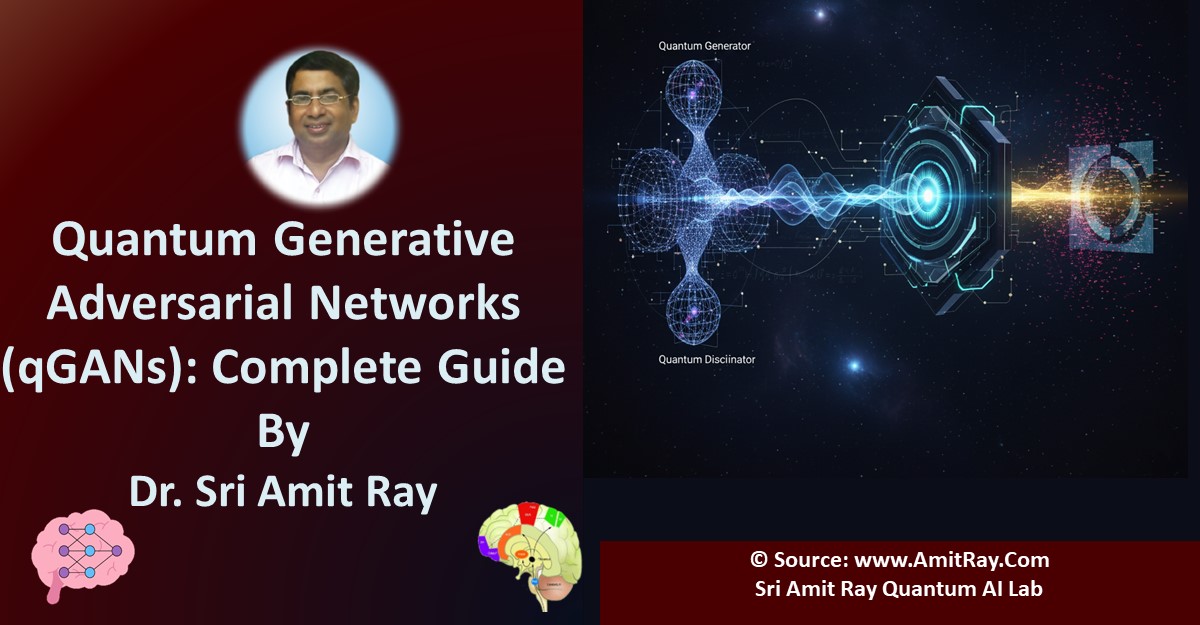
    Quantum Generative Adversarial Networks (qGANs) merge the generative power of classical Generative Adversarial Networks (GANs) with quantum computing's unique capabilities, such as superposition and entanglement, to model complex data distributions. As of September 2025, qGANs are pivotal in quantum machine learning (QML), offering potential exponential speedups for tasks like data augmentation and quantum state generation. This guide provides a comprehensive roadmap for implementing qGANs, from theoretical foundations to practical deployment on Noisy Intermediate-Scale Quantum (NISQ) devices, drawing on recent advancements [1, 2, 3].

    A classical GAN consists of two main components trained in a zero-sum game: a Generator and a Discriminator. In a qGAN, the generator is typically replaced with a Quantum Generator—a parameterized quantum circuit that produces classical data upon measurement. The discriminator often remains a classical neural network, creating a powerful hybrid approach [3].

    Read more ..
    Quantum Cheshire Cat Generative AI Model

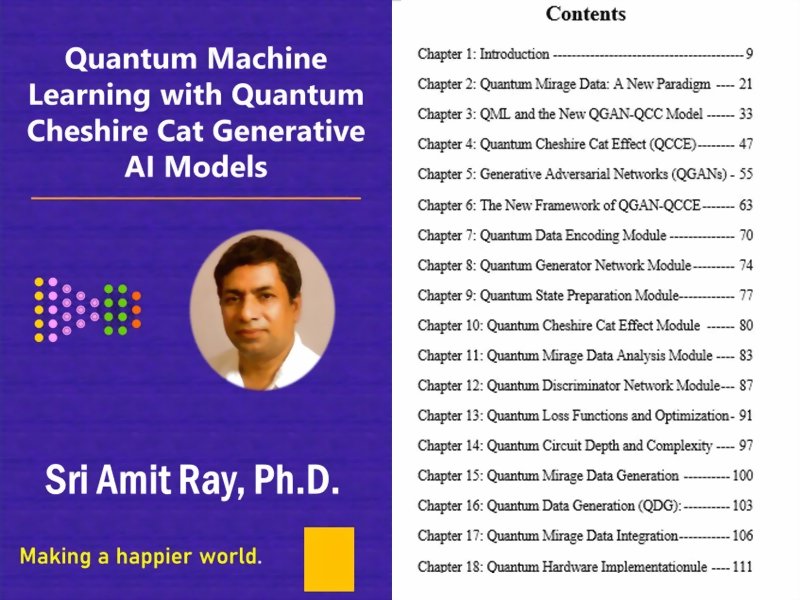
    "Quantum Cheshire Cat Generative AI Model" is a book written by Sri Amit Ray is a groundbreaking exploration into the realm of Quantum Machine Learning, introducing a novel model that integrates the principles of Quantum Cheshire Cat phenomenon and Quantum Generative Adversarial Networks (QGANs). This book also introduced the concepts of Quantum Mirage Data in the field of machine learning for the first time.

    Quantum Cheshire Cat Generative AI Model

    Quantum Cheshire Cat Generative AI Model

    Read more ..


    Quantum Computing and Artificial Intelligence

    Quantum Computing and Artificial Intelligence

    Here, Sri Amit Ray discusses the power, scope, and challenges of Quantum Computing and Artificial Intelligence in details.

    In recent years there has been an explosion of interest in quantum computing and artificial intelligence. Quantum computers with artificial intelligence could revolutionize our society and bring many benefits. Big companies like IBM, Google, Microsoft and Intel are all currently racing to build useful quantum computer systems. They have also made tremendous progress in deep learning and machine intelligence.  

    Quantum Computing and Artificial Intelligence

    Artificial intelligence (AI) is an area of science that emphasizes the development of intelligent systems that can work and behave like humans. Quantum computing is essentially using the amazing laws of quantum mechanics to enhance computing power. These two emergent technologies will likely have huge transforming impact on our society in the future. Quantum computing is finding a vital platform in providing speed-ups for machine learning problems, critical to big data analysis, blockchain and IoT. 

    The main purpose of this article is to explain some of the basic ideas how quantum computing in the context of the advancements of artificial intelligence; especially quantum deep machine learning algorithms, which can be used for designing compassionate artificial superintelligence.

    Read more ..


Contact us | About us | Privacy Policy and Terms of Use |

Copyright ©AmitRay.com, 2010-2024, All rights reserved. Not to be reproduced.