
Introduction
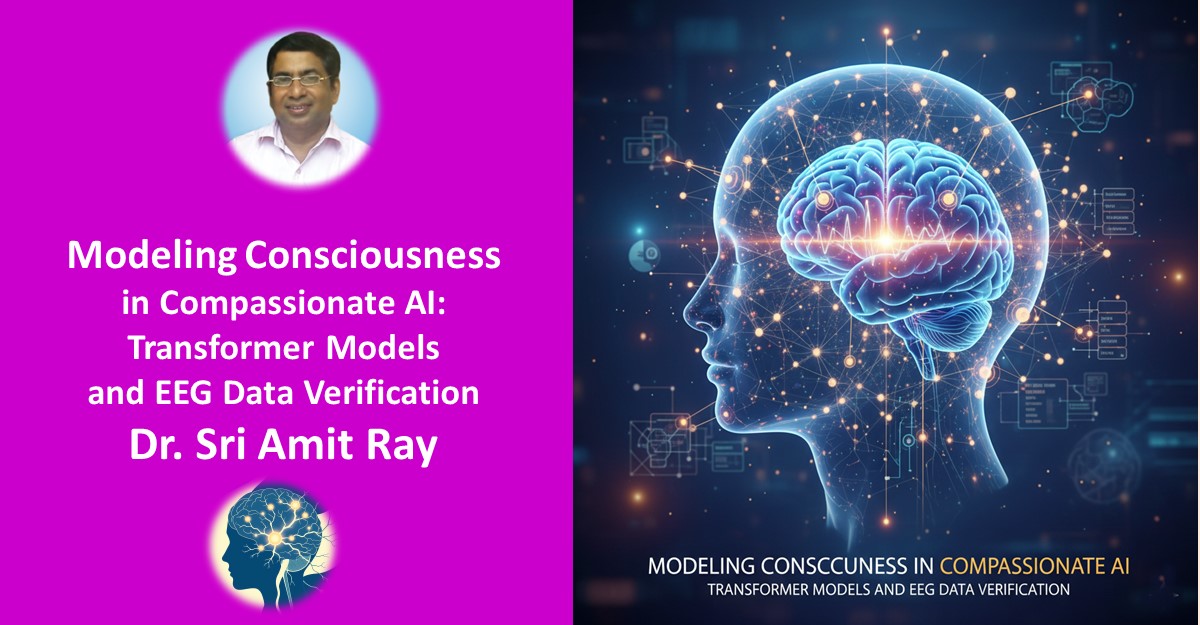
Consciousness remains one of the most enigmatic phenomena in science, defying straightforward explanation despite centuries of inquiry. Recent advances at the intersection of neuroscience, artificial intelligence, and dynamical systems theory offer a promising new framework: modeling consciousness as a dynamical system governed by neural attractor networks [Ray, 2025]. This approach conceptualizes conscious states—such as wakefulness, sleep, or focused attention—as stable, recurring patterns of neural activity, termed attractors, within the brain’s intricate network [Fakhoury et al., 2025]. By leveraging advanced computational tools like transformer models and neural differential equations, researchers are beginning to map the dynamic landscapes of the mind, offering insights into the nature of consciousness and its potential applications in diagnostics and treatment. In this article, by integrating transformer models, electroencephalogram (EEG) data verification, and holistic frameworks we aim to create AI systems that not only mimic consciousness but also embody compassionate behaviors aligned with human values.
Foundations: Neural Attractors in Phase Space
A dynamical system describes how a system’s state evolves over time, often visualized in a phase space where each point represents a unique configuration of the system’s variables. In the brain, this phase space is extraordinarily high-dimensional, with each dimension corresponding to the activity of a neuron or neural population. The trajectory of the brain’s state through this space is not random; it converges toward specific regions known as attractors—stable patterns of activity that the system naturally gravitates toward.
Read more ..