
Makar Sankranti 2026 will be observed on Wednesday, 14 January 2026, marking one of the most powerful solar transitions in the Vedic calendar. The most sacred astrological moment—Sankranti Muhurat—commences at 3:13 PM, opening the gateway to the highly auspicious Maha Punya Kaal.
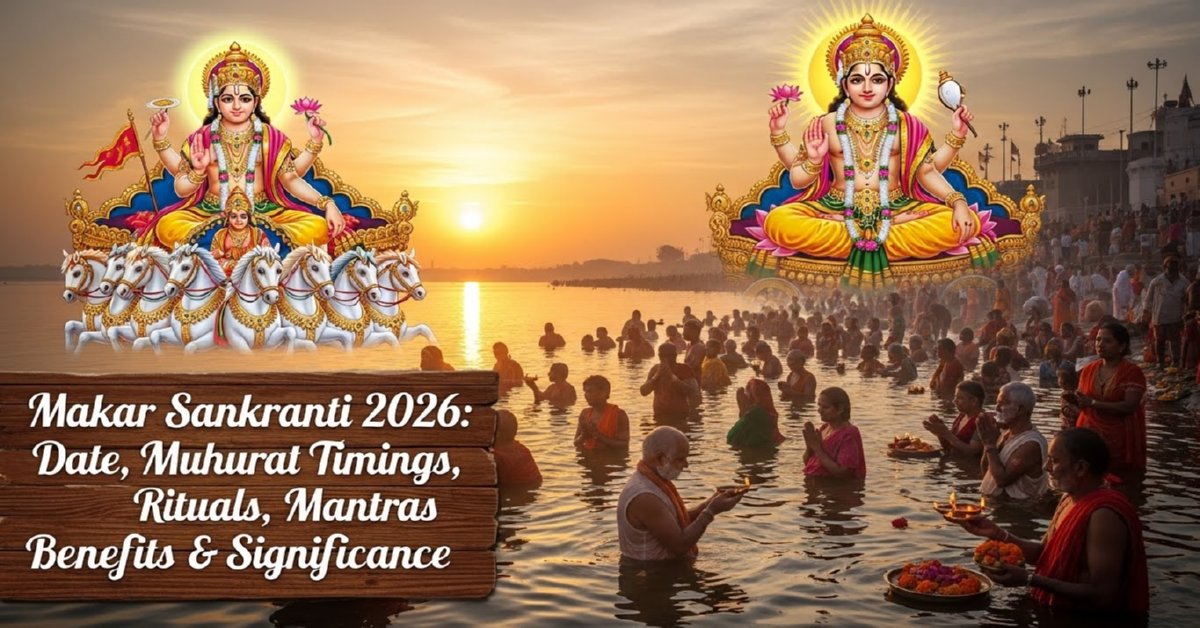
It marks the day when Surya Dev (the Sun God) enters Makara Rashi (Capricorn), initiating his sacred Uttarayan—the northward celestial journey. This transition signifies the end of the winter solstice and the gradual return of longer, brighter days, symbolizing the eternal triumph of light over darkness, knowledge over ignorance, and consciousness over inertia.
Makar Sankranti (Uttarayana) – Wednesday, January 14, 2026 | Sun enters the Makara Rashi (Capricorn)
Makar Sankranti Moment – 03:13 PM on January 14, 2026
Makar Sankranti Punya Kala – 03:13 PM to 05:45 PM
Duration – 02 Hours 32 Mins
Makar Sankranti Maha Punya Kala – 03:13 PM to 04:48 PM
Duration – 01 Hour 45 Mins
Note: All timings are for India Standard Time (IST). Rituals performed during Punya Kala yield maximum spiritual benefits.
Unlike most Hindu festivals governed by the lunar calendar, Makar Sankranti is determined by the solar cycle, which keeps its date nearly constant each year around 14th-January. In 2026, this sacred occasion carries profound spiritual, astrological, and agricultural significance, uniting cosmic rhythms with human life.
Scriptures affirm that rituals such as holy bathing (Snāna), charity (Dāna), japa, and Sun worship performed during this precise window generate multiplied spiritual merit, attracting divine grace, inner purification, and lasting prosperity. Known also as Maghi, Makar Sankranti is among the most ancient and universally celebrated Hindu festivals.
Through rituals, sacred offerings, seasonal harvest celebrations, and acts of selfless giving, Makar Sankranti becomes a festival of renewal, gratitude, abundance, and spiritual awakening, guiding seekers toward harmony with the cosmic order.
Makar Sankranti 2026: Exact Date & Auspicious Timings (Muhurat)
For devotees and astrologers, the precise timing of Makar Sankranti is paramount. In 2026, the festival holds special significance due to its afternoon Muhurat.
- Makar Sankranti 2026 Date: Wednesday, January 14, 2026
- Sankranti Moment (Sun Enters Capricorn): 3:13 PM (Indian Standard Time)
- Maha Punya Kaal Duration: 3:13 PM to 04:48 PM (1 hour 45 minutes)
- Punya Kala Duration: 3:13 PM to 5:45 PM (2 hours 32 minutes)
- Festival Day: Makar Sankranti / Pongal / Uttarayan
Pro Tip for Maximum Blessings: Schedule your holy bath, Surya Arghya (water offering to Sun), and main charity donations to occur between 3:13 PM and 04:48 PM on January 14, 2026. This aligns your actions with the peak cosmic energy of the Sun’s transition.
Sun in Makara Rashi: The Sun-Saturn Fusion of 2026
The Sun entering Makara Rashi (Capricorn) on January 14, 2026, at 3:13 PM creates a profound astrological fusion—the meeting of the Sun (Surya) with Saturn (Shani), Capricorn’s ruling planet. This Sun-Saturn conjunction symbolizes a powerful cosmic alignment where solar vitality (Surya’s energy of soul, authority, and willpower) merges with Saturnian discipline (Shani’s principles of karma, structure, and perseverance).
The Transformative Influence
The influence of this transit is deeply transformative. It encourages an individual to embrace responsibility, allowing for the reaping of karmic rewards from past efforts while building lasting foundations through dedicated hard work. Spiritually, it signifies the soul’s journey toward maturity and enlightenment through the navigation of life’s trials.
Core Significances of the Fusion
- Authority vs. Discipline: A balance between the ego’s desire for recognition and the structural needs of society.
- Karmic Ripening: Saturn, the lord of Karma, ensures that the Sun’s creative power is applied ethically and sustainably.
- Dharmic Alignment: A unique window to set long-term goals that are not just ambitious, but spiritually aligned.
Makar Sankranti 2026: A Potent Window
This fusion makes Makar Sankranti 2026 an exceptionally potent time for several key activities:
- Spiritual Practice: Initiating disciplined Sadhana or meditation routines that require long-term commitment.
- Charitable Acts: Performing Daana (charity) to balance one’s karmic debt and soften the stern influence of Shani.
- Goal Setting: Establishing foundations for projects intended to last for years rather than months.
Under this celestial partnership, actions taken are believed to carry amplified and enduring consequences. It is a time when the universe rewards those who act with integrity, patience, and a sense of duty toward their higher self.
The Astrological Remedy: Sun meets Saturn
In Vedic astrology, the Sun and Saturn are a father and son who have a difficult relationship. The significance of til (sesame seeds) and jaggery is deeply rooted in Makar Sankranti traditions. Foods made with these ingredients help keep the body warm during winter and symbolically promote sweetness, harmony, and unity in relationships.
Til (Sesame) is the grain of Saturn: It represents discipline, protection, and the removal of “Shani Dosha” (obstacles).
Jaggery is the food of the Sun: It represents vitality, warmth, and the ego’s sweetness.
The Fusion: By mixing them together (as Til-Gul), you are symbolically harmonizing these two opposing forces. It is a ritual of reconciliation—honoring the discipline of Saturn while inviting the light of the Sun.
What to Do During Maha Punya Kaal (3:13 PM – 04:48 PM)?
The Maha Punya Kaal on January 14, 2026, from 3:13 PM to 04:48 PM, is not a regular time. It is a condensed window of immense spiritual potential. Here is the order of rituals recommended by priests:
- Holy Bath (Snan): Take a bath with til (sesame) seeds in water before or at the start of Maha Punya Kaal. If at a river, this bath should be completed by 3:13 PM.
- Surya Arghya & Puja: Immediately after bathing, offer fresh water to the setting sun (during this afternoon period) while chanting the Surya Mantra. Perform a brief Sun God worship.
- Charity (Daan): This is the MOST important act during Maha Punya Kaal. Donate the following items between 3:13 PM and 04:48 PM:
- Til Daan: Black sesame seeds mixed with jaggery.
- Gud Daan: Jaggery lumps.
- Blankets & Woolens (Kambal Daan): Essential for winter.
- Anna Daan: Offer freshly cooked Khichdi or rice to the needy.
- Tarpan for Ancestors: Offer water with black sesame seeds to departed ancestors, seeking their blessings.
- Consume Til-Gul: Exchange and eat sesame-jaggery sweets with family, promising sweet discourse.
Utttarayan and the 12 Ray Aditya Chakras
Uttarayana, the northward movement of the Sun from Makara Sankranti onward, represents a fundamental solar shift in which light, duration of day, and upward-moving life forces progressively increase. In the Sri Amit Ray tradition of spirituality, Uttarayana is not merely an astronomical event but a phase of heightened solar coherence that directly influences human physiology, cognition, and subtle energy systems.
In the tradition of Sri Amit Ray 114 Chakras, the Ray 12 Aditya Chakras represent a higher-order solar consciousness framework that extends well beyond the classical seven-chakra model, situating human awareness within the larger architecture of cosmic and astrophysical rhythms. Rooted in the Vedic principle of the twelve Adityas—the twelve luminous expressions of the Sun governing time, seasons, and life cycles—this chakra system interprets solar dynamics as operative forces within the subtle human energy field.
In the Ray paradigm, the Sun is not merely a physical star but a regulator of biological rhythms, neural coherence, mitochondrial vitality, and higher cognition. The twelve Aditya Chakras function as solar resonance nodes that translate macrocosmic solar intelligence into microcosmic states of perception, will, clarity, and evolutionary intent, thereby linking astrophysical order with interior consciousness.
As the Sun ascends in its apparent path, circadian regulation, mitochondrial efficiency, and neuroendocrine balance receive stronger solar entrainment. This period is traditionally regarded as favorable for discipline, tapas, meditation, and knowledge-oriented pursuits because the solar field supports clarity, stability, and sustained awareness. Uttarayana thus establishes the external cosmic condition required for deeper internal alignment with solar intelligence.
Within this solar ascent, the 12 Ray Aditya Chakras function as twelve progressive gateways through which solar consciousness is assimilated into human awareness. Each Aditya Chakra corresponds to a specific aspect of the Sun’s regulating intelligence—illumination, order, vitality, discernment, and transcendence—and collectively they map the integration of time, rhythm, and purpose within the subtle body. During Uttarayana, these chakras are considered more accessible to activation, as the upward solar flow naturally supports higher cognitive integration and refined perception of time and self.
Unlike the basic seven-chakra model, which primarily governs survival, emotion, and expression, the 12 Ray Aditya Chakras facilitate systematic expansion beyond personal identity into solar-aligned intelligence, enabling practitioners to stabilize higher states of awareness in harmony with cosmic order.
Furthermore, the festival’s emphasis on solar energy ties into chakra systems, such as the Manipura Chakra (Solar Plexus), which correlates with metabolic rate, autonomic balance, and motivation—mirroring mitochondrial density and function. Health benefits include optimized energy production, stress tolerance, emotional stability, and immune coherence.
Powerful Mantras to Chant During Makar Sankranti 2026
Amplify the effects of the 3:13 PM Muhurat by chanting these mantras with devotion. Each mantra serves a specific purpose and is traditionally prescribed for Makar Sankranti rituals.
1. Primary Surya Gayatri Mantra (For Ultimate Sun’s Blessings)
ॐ भास्कराय विद्महे महातेजाय धीमहि । तन्नः सूर्यः प्रचोदयात् ॥
Om Bhāskarāya Vidmahe Mahātejāya Dhīmahi | Tannaḥ Sūryaḥ Prachodayāt ||
Meaning: “Om, may we know the radiant Sun God; we meditate upon the one of supreme brilliance. May that Surya inspire/illuminate our intellect.”
Best for: Overall spiritual enlightenment, intellect, and receiving the Sun’s divine grace. Chant 108 times during the Maha Punya Kaal.
2. Japakusuma Sankasha Mantra (For Surya Deva’s Direct Worship)
ॐ जपाकुसुम संकाशं काश्यपेयं महाद्ध्युतं तमोरिं सर्वपापघ्नं प्रणतोस्मि दिवाकरं ॥
Om Japākusuma saṅkāśaṁ kāśyapeyaṁ mahādhyutam tamōriṁ sarvapāpaghnaṁ praṇatōsmi divākaraṁ ||
Meaning: “I bow to the Sun, who is radiant like the hibiscus flower, the son of Kasyapa, immensely brilliant, the destroyer of darkness and all sins, the maker of the day.”
Best for: Cleansing sins (pāpaghna), dispelling darkness (ignorance), and direct worship during Surya Arghya offering.
3. Special Bija Mantra for Prosperity & Energy
ॐ ह्रीं घृणिः सूर्य आदित्यः क्लीं ॐ ।
Om hrīṁ ghṛṇiḥ sūrya ādityaḥ klīṁ om |
Meaning: A powerful combination of seed syllables (Bija) invoking the radiant Sun God Aditya for attraction and energy.
Best for: Attracting prosperity, wealth, and vital solar energy. Ideal for chanting while offering Arghya at 3:13 PM.
4. Mantra for Fulfillment of Desires (Manokamana Siddhi)
ॐ ह्रीं ह्रीं सूर्याय सहस्रकिरणराय मनोवांछित फलं देहि देहि स्वाहा ॥
Om hrīṁ hrīṁ sūryāya sahasra-kiraṇarāya manovāṁchita phalaṁ dehi dehi svāhā ||
Meaning: “Om, Hreem Hreem, to the Sun God with a thousand rays, grant-grant the fruit of my heart’s desires, Svaha.”
Best for: Manifesting specific wishes and desires when performing Sankranti charity or puja.
5. Simple Surya Mantras (For Jal Arpan & Continuous Chanting)
ॐ सूर्याय नमः
(Om Sūryāya Namaḥ) – Basic salutation for water offering.
ॐ ह्रीं ह्रीं सूर्याय नमः
(Om hrīṁ hrīṁ sūryāya namaḥ) – Energized salutation with Bija mantras.
ॐ ऐहि सूर्य सहस्त्रांशों तेजो राशे जगत्पते, अनुकंपयेमां भक्त्या, गृहाणार्घय दिवाकरः
(Om aihi sūrya sahasrāṁśoṁ tejo rāśe jagatpate, anukaṁpayemāṁ bhaktyā, gṛhāṇārghaya divākaraḥ)
Meaning: “Come, O Sun, thousand-rayed, heap of splendor, Lord of the universe; have mercy on me with devotion; accept this offering, O maker of the day.”
Best for: Continuous repetition (japa) throughout the day and during the ritual of offering water (Jal Arpan) to the Sun.
6. Mantra for Ancestral Peace (Pitra Tarpan)
Devanagari: ॐ पितृगणाय विद्महे जगत्धारिण्यै धीमहि तन्नो पितृः प्रचोदयात् ॥
IAST: Om Pitṛgaṇāya Vidmahe Jagaddhāriṇyai Dhīmahi Tanno Pitṛḥ Prachodayāt ||
Meaning: “Om, let us meditate on the host of ancestors, the sustainer of the world; may those ancestors inspire/guide us.”
Best for: Offering water (Tarpan) to departed ancestors, seeking their blessings and peace. Crucial for removing ancestral karma (Pitru Dosha).
How to Use These Mantras Effectively
- During Maha Punya Kaal (3:13 PM – 5:02 PM): Focus on Mantras 1, 2, and 3 for maximum cosmic alignment.
- For Jal Arpan (Water Offering): Use Mantra 2 (Japakusuma) or Mantra 5 (simple chants) while pouring water.
- During Daan (Charity): Chant Mantra 4 silently while donating Til-Gul, blankets, or food.
- For Tarpan (Ancestral Offering): Use Mantra 6 exclusively with offerings of black sesame and water.
- General Japa: Use Mantra 5 for continuous, easy repetition throughout the day to maintain a sacred vibration.
- Mala/Japa Beads: Chant 108 repetitions of your chosen primary mantra using a Rudraksha or Sphatik mala.
Pro Tip: For the most profound results in 2026, synchronize your chanting with the exact Sankranti moment at 3:13 PM. Begin your mantra japa at this time and continue through the Maha Punya Kaal to harness the Sun-Saturn fusion energy for spiritual and material transformation.
Step-by-Step Puja Vidhi for Makar Sankranti January 14, 2026
Follow this structured worship plan to align with the 3:13 PM Maha Punya Kaal.
Preparations (Before 3:13 PM):
- Clean the puja area. Place an image or kalash (pot) symbolizing Lord Surya.
- Prepare offerings: Water in copper pot, red flowers, incense, diya, til, gul, rice, fruits, and seasonal vegetables.
- Prepare Daan items separately: Two packets of til-gul, a blanket, and food grains.
During Maha Punya Kaal (3:13 PM Onwards):
- 3:13 PM: Light the diya and incense. Offer flowers to the Sun God.
- Arghya: Facing the West (sunset direction), pour water from the copper pot slowly while chanting the Surya Gayatri Mantra.
- Offer Prasad: Offer til, jaggery, and fruits to the deity.
- Perform Daan: This is crucial. Hand over the prepared Daan items to a priest, needy person, or into flowing water between 3:13 PM and 04:48 PM.
- Prayer: Meditate and pray for the Sun’s guidance, prosperity for all, and peace for ancestors.
Why is the 3:13 PM Time on January 14, 2026, So Significant?
The importance of the Makar Sankranti Muhurat at 3:13 PM is deeply rooted in astronomy and mythology.
1. Astronomical Significance: The Solar Gateway
At 3:13 PM on January 14, 2026, the Sun completes its southern journey (Dakshinayana) and begins its northward ascent (Uttarayana). This precise second is a celestial “gateway.” Performing rituals at this juncture aligns an individual’s energy with this positive cosmic shift.
2. Scriptural Promise of Multiplied Merit
Vedic texts like the Puranas promise that any positive karma (bathing, charity, japa) done during the Sankranti moment and the following Maha Punya Kaal earns merits many times greater than on ordinary days. The 1-hour 45-minute window from 3:13 PM is your best opportunity for spiritual investment in 2026.
3. The Confluence of Light and Time
This afternoon timing in 2026 symbolizes a balance. The Sun, having provided daylight, is preparing to set but its spiritual power is at a peak during its transition. Offering Arghya at this time is a gratitude for the day’s light and a prayer for its return tomorrow.
4. Historical & Mythological Origins
The festival is rooted in various ancient texts and legends:
- Legend of Lord Surya and His Son: It is believed that on this day, Lord Surya (Sun God) visits the house of his son, Shani (Saturn, the lord of Capricorn), symbolizing reconciliation.
- The Story of Bhagirath and Ganga’s Descent: Makar Sankranti is associated with the descent of the holy river Ganga to Earth, purifying the ashes of King Bhagirath’s ancestors.
- Agricultural Significance: Historically, it is the harvest festival for Rabi crops. Farmers celebrate the yield and offer the first harvest to the gods as gratitude.
Eternal Benefits of Charity (Daan)
Charity is the cornerstone of Makar Sankranti, especially during the Maha Punya Kaal. Here’s why acting at 3:13 PM is transformative:
- Breaks Negative Cycles (Karma): Donating til, associated with Lord Shani (Saturn), during this time mitigates Saturn’s malefic effects and past karma.
- Attracts Eternal Prosperity (Lakshmi): Giving jaggery (sweetness) and food is believed to please Goddess Lakshmi, ensuring financial stability is not just for one life but carries forward.
- Health & Warmth: Donating blankets and woolens during winter directly earns the blessing of good health and protection from ailments.
- Ancestral Liberation (Moksha): Charity done in the name of ancestors during this period helps elevate their souls, bringing their eternal blessings upon you.
- Spiritual Merit (Punya) Bank: Scriptures state that the merit earned from Daan at this specific time becomes a spiritual asset that yields happiness and protection across lifetimes.
Actionable Tip: Prepare your Daan items a day before. At 3:13 PM sharp on January 14, 2026, perform your Surya Puja and then immediately give your donations. This sequence locks in the maximum benefit.
Scientific Significance of Makar Sankranti Traditions
Makar Sankranti, celebrated on January 14, 2026, marks the Sun’s northward journey (Uttarayan), bringing longer, brighter days after winter. Ancient rituals like offering Arghya (water) to the rising Sun at sunrise and spending time outdoors flying kites align remarkably with modern science, which highlights the profound benefits of natural sunlight exposure for physical, mental, and cognitive health.
1. Enhanced Cognitive Function & Reduced Sleepiness
Recent research shows that higher daytime light exposure (similar to bright natural sunlight during Uttarayan) significantly reduces subjective sleepiness, speeds up reaction times, and improves performance in tasks involving vigilance, working memory, and visual search.
- A 2025 study in Communications Psychology found that brighter, stable daytime light patterns lead to faster cognitive reactions (up to ~60 ms improvement) and lower sleepiness scores.
- Source: Relationships between light exposure and aspects of cognitive function in everyday life (Didikoglu et al., 2025)
This supports the spiritual clarity and alertness gained from early morning sun rituals on Sankranti.
2. Improved Mood, Memory & Sleep Quality
Spending more time outdoors in natural light predicts higher positive mood, better circadian alignment, enhanced memory, and superior sleep quality — countering winter lethargy.
- Increased outdoor time directly boosts positive affect and advances circadian rhythms for better overall well-being.
- Source: Light exposure behaviors predict mood, memory and sleep quality (Scientific Reports, 2023)
3. Reduced Risk of Depression & Vitamin D Benefits
Moderate outdoor sunlight exposure (around 1–2 hours/day, optimal in winter) lowers depression risk, even with genetic predispositions, through vitamin D synthesis and circadian regulation.
- The ideal duration (~1.5 hours/day on average) minimizes depression incidence via natural mechanisms.
- Source: Association of time spent in outdoor light and genetic risk with the incidence of depression (Translational Psychiatry, 2023)
Additionally, early morning sun exposure during festivals like Makar Sankranti promotes optimal vitamin D absorption, supporting bone health, immunity, and energy — perfectly timed with the post-winter solstice increase in sunlight intensity.
Ancient wisdom meets modern science: The traditions of Makar Sankranti not only honor the Sun God but also promote holistic well-being through evidence-based benefits of natural light.
4. Solar Rotations
As Makar Sankranti 2026 heralds the Sun’s auspicious northward journey (Uttarayana) on January 14th at 3:13 PM—celebrating the Sun’s entry into Makara Rashi and the post-winter solstice shift toward longer days—the festival honors the Sun’s dynamic power that ancient seers revered through ritual and astronomy.
This divine transition coincides with fascinating solar behavior that modern heliophysics explains: the Sun is not a solid body but a sphere of superheated plasma that rotates differentially, completing a turn faster at its equator (~25 days) than at its poles (~35 days).
This “solar yoga” of fluid motion, driven by plasma dynamics and convection, is fundamental to generating the Sun’s magnetic fields and the 11-year solar activity cycle that influences space weather and subtly interacts with Earth’s own 23.5° axial tilt—the very tilt responsible for our seasons and the significance of the solstice Sankranti marks.
This scientific reality adds a profound layer to the spiritual concept of Surya Dev’s transformative energy. Explore this celestial mechanics through NASA’s visualization of Solar Rotation Varies by Latitude. To understand more about our life-giving star whose sacred transition we celebrate, delve into NASA’s comprehensive resource: Sun: In Depth.
Journey of the Soul in Uttarayana
As the Sun begins its auspicious northward journey during Uttarayana—celebrated with joy on Makar Sankranti, January 14, 2026—Vedic traditions view this period as the prime time for the soul’s radiant ascent toward higher consciousness and liberation.
Modern neuroscience beautifully complements this ancient insight, showing how rising daylight influences the brain’s master clock, boosts serotonin and gamma wave activity for deeper meditative states, and fosters neural growth conducive to spiritual awakening and serene inner transformation. Explore this profound fusion of biology and the soul’s eternal path in our in-depth article: Neuroscience of the Soul’s Journey Through Uttarayana: Biology and Consciousness.
Makar Sankranti Across India: Regional Names & Celebrations
- Pongal (Tamil Nadu): A 4-day harvest festival featuring Bhogi, Thai Pongal, Mattu Pongal, and Kaanum Pongal.
- Uttarayan (Gujarat): Famous for its international kite flying festival.
- Maghi (Punjab & Haryana): Marked by ritual baths, eating kheer, and fairs.
- Bihu (Assam): Magh Bihu is celebrated around this time with feasts (Bhogali Bihu).
- Khichdi Parv (Uttar Pradesh & Bihar): Donating Khichdi, til, and woolen items.
- Makar Sankramana (Karnataka & Andhra Pradesh/Telangana): Elaborate pooja, new clothes, and sharing Ellu Bella (til-jaggery mix).
Frequently Asked Questions (FAQs) about Makar Sankranti 2026
What Is Makar Sankranti?
Makar Sankranti, also known as Maghi, is one of the most ancient and widely celebrated Hindu festivals in India. It marks the day when Surya Dev (the Sun God) enters Makara Rashi (Capricorn zodiac sign), initiating his sacred northward journey known as Uttarayan. This solar transition signifies the end of the winter solstice and the gradual increase of daylight, symbolizing the victory of light over darkness and knowledge over ignorance.
Is Makar Sankranti on January 14 or 15 in 2026?
In 2026, Makar Sankranti is definitively on January 14th. The Sankranti moment occurs at 3:13 PM on that day.
I cannot bathe in a river at 3:13 PM. What should I do?
You can take a symbolic bath at home. Add a few black sesame seeds and a drop of Ganga Jal (if available) to your bathwater before 3:13 PM. Then, at 3:13 PM, stand in your home and offer Arghya (water) to the Sun from your balcony or window.
What is the single most important thing to do at 3:13 PM?
The single most powerful action is Daan (Charity). If you can only do one thing, ensure you donate til, gud, or a blanket to a needy person between 3:13 PM and 04:48 PM.
Why is the Maha Punya Kaal only 1 hour 45 minutes long in 2026?
The duration of Maha Punya Kaal is calculated astronomically based on the time of sunset and the Sankranti moment. Each year it varies. In 2026, this specific window (3:13 PM – 04:48 PM) is divinely ordained for optimal results.
Can I fly kites during the Maha Punya Kaal?
Yes, kite flying is a joyous tradition but is not a ritual. Prioritize your Puja, Daan, and Mantra Japa between 3:13 PM and 04:48 PM. You can fly kites before or after this sacred window.
Is Makar Sankranti a good day for new beginnings?
Absolutely. Uttarayana is considered an auspicious “day of the gods” for starting new ventures, educational pursuits, buying assets, or performing housewarming ceremonies (Griha Pravesh).
Summary:
Summary for Makar Sankranti 2026: Mark your calendar for Wednesday, January 14, 2026. Set an alarm for 3:13 PM. Use the following 1 hour 45 minutes (until 04:48 PM) for holy bathing, Sun worship, and profound acts of charity. By aligning with this precise cosmic schedule, you harness the festival’s full potential for eternal merit, prosperity, and happiness in the new solar cycle.