
The Hanuman Chalisa is far more than a devotional hymn; it is a highly refined, time-tested healing protocol embedded within India’s spiritual heritage. Modern neuroscience is only now beginning to illuminate how and why its rhythmic, symbolic, and vibrational architecture influences trauma, memory, and nervous-system regulation.
The hymn is not only a cornerstone of deep love and devotion but also resonates deeply with spiritual practices involving activating the heart chakras, Sanjivani Chakras and the Guru Chakra, within the Sri Amit Ray Tradition, of the 114 chakras. The Hanuman Chalisa activates and rebalances the 10 primary Vayu Chakras, and the Sanjivani chakras in human energy system.
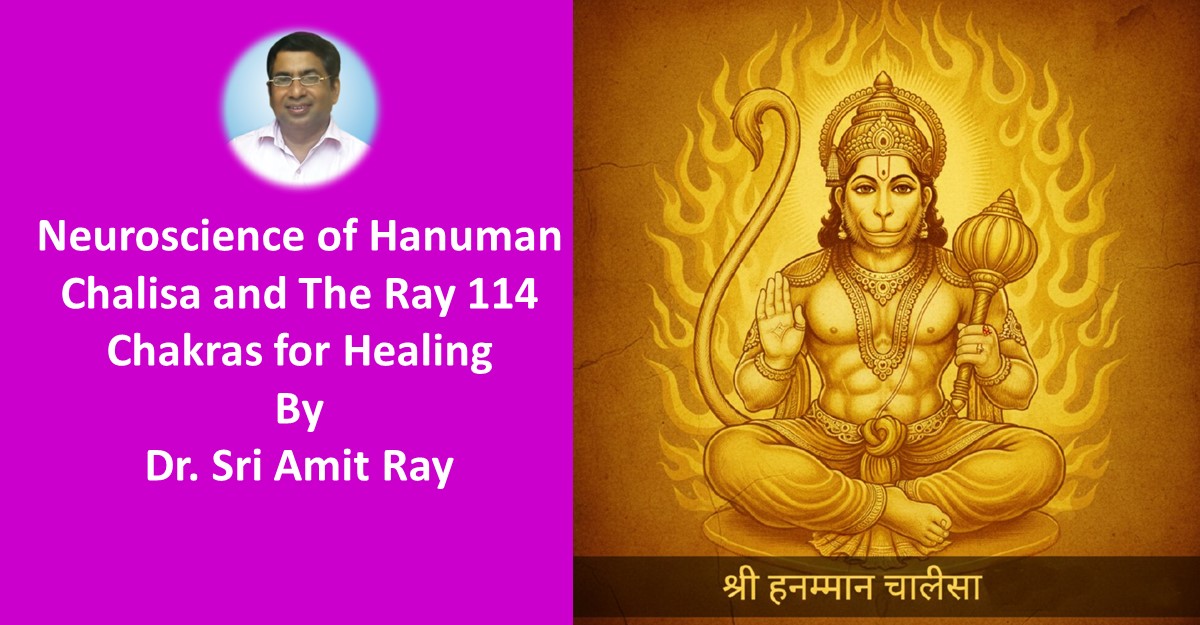
Across India and increasingly around the world, millions instinctively turn to the Hanuman Chalisa in moments of fear, crisis, or emotional exhaustion—experiencing an immediate sense of protection, strength, and inner calm. What was once attributed solely to faith and devotion is now revealing itself as a sophisticated vibrational healing technology, precisely engineered over centuries to repair the human nervous system at its deepest levels.
This article explores the precise neuro-spiritual mechanisms through which the 40 verses of the Hanuman Chalisa ignite the four main chakra networks within the Ray 114 Chakras, offering a bridge between ancient wisdom and modern science for profound, lasting healing.
The article integrates three converging domains: contemporary models of stress, strain, anxiety, trauma and autonomic dysregulation; the psychoacoustic and devotional potency of the Hanuman Chalisa; and Sri Amit Ray’s 114 Chakra framework, which conceptualizes human consciousness as a network of finely graded energy-transduction centers. Together, these streams form a unified map for transforming embodied contraction, emotional inertia, and fragmented inner states into ascending clarity, resilience, and coherence.
Key idea: the 114 chakras act as energy transducers — converting raw prāṇa into bodily vitality, emotional equilibrium and higher insight. When lower-graded centers are clogged with tamas (inertia) produced by fear, unresolved trauma, and egoic contractions, the whole conduit becomes inefficient. Purification is the cascade that clears lower obstructions so prāṇa can ascend to illumine the upper koshas and cosmic chakras.
Introduction:
In moments of acute fear, overwhelming grief, or paralysing anxiety, millions of people across the world do one simple thing: they begin chanting the Hanuman Chalisa. Within minutes, the heart rates slow, breathing deepens, tears may flow, and an inexplicable sense of safety and strength returns. What feels like divine grace is increasingly being understood as one of the most powerful, precise, and scientifically aligned vibrational healing technologies ever created by the human spirit.

At the leading edge of this understanding stands the Ray 114 Chakra system, developed by Sri Amit Ray. Moving far beyond the familiar seven-chakra model, this advanced framework maps 114 high-frequency energy centers throughout the body and biofield. When the forty sacred verses of the Hanuman Chalisa are recited with rhythm and devotion, three clusters of these chakras ignite in perfect sequence:
- The Suraksha Chakra network and the Sanjivani chakra network, the ultra-subtle protective fields, and healing network that rapidly dissolve chronic fear states and restore an embodied, unbreakable sense of safety
- The 10 Vayu Chakras – dynamic pranic vortices that mobilise and release long-held traumatic imprints through regulated breath and gentle somatic discharge
- The 12 Chitta-Shuddhi Chakras – The cognitive healing, emotional expansion, freedom and resilience building.
- The 11 Rudra Chakras – fierce-yet-compassionate healing centers that directly restructure the deep limbic brain, transmuting stored anger, betrayal, and fragmentation into clarity, forgiveness, and emotional resilience.
As these chakras synchronise, a cascade of measurable physiological shifts occurs: prana recalibrates, vagal tone strengthens, traumatic memory fragments are reconsolidated, and cellular vibration returns to coherence. Cutting-edge research in polyvagal theory, sound-frequency medicine, trauma neuroscience, and neuroplasticity now increasingly confirms what India’s ancient rishis encoded in sonic form thousands of years ago.
Rhythmic recitation of the Hanuman Chalisa consistently down-regulates hyperactive amygdala responses, interrupts rumination loops in the default mode network, enhances heart-rate variability, and triggers profound rewiring of stress-hardened neural pathways – outcomes that frequently surpass those of many modern therapeutic modalities.
The Hanuman Chalisa is no longer “just” a devotional hymn. It is revealed as one of humanity’s most potent spiritual medicines – a living, time-tested protocol that dismantles the neurological scars of trauma, reawakens innate fearlessness, and guides the entire human system back to its original blueprint of radiant, unbreakable coherence.
This article bridges the timeless wisdom of the Hanuman Chalisa with the Ray 114 Chakra activation and contemporary neuroscience – offering a clear, practical pathway for anyone seeking lasting emotional freedom and deep nervous-system repair.
The Layered Symbolism of Hanuman Chalisa: Archetypes as Mirrors of the Soul
The Chalisa’s verses unfold Hanuman’s essence like petals of a lotus, each archetype a key to unlocking layered healing. Far from a linear narrative, it invites devotees to embody these facets simultaneously, reflecting trauma’s non-linear scars—flashes of vulnerability amid strength, surrender veiled in service.
The Child: Reclaiming Innocence in the Lower Chakras
Hanuman as the mischievous child who swallows the sun symbolizes untainted curiosity and boundless potential, evoking the lower chakras’ “softness”—Muladhara (root) for security and Svadhisthana (sacral) for creative flow. Trauma often severs this innocence, embedding fear in survival circuits. Chanting verses like “Yug Sahasra Yojan Par Bhaanu, Leelyo Taahi Madhur Phal Jaanu” (mistaking the sun for sweet fruit) reignites childlike wonder, softening rigid defenses. Inner-child activation involves accessing and soothing the emotional imprints, which often manifest as irrational fears or emotional reactivity rooted in childhood wounds.
The Warrior: Protection in the Middle Chakras
As the thunderbolt-wielding Mahabir (“Mahaabeer Bikram Bajrangi“), Hanuman guards against inner demons, aligning with Manipura (solar plexus) for willpower and Anahata (heart) for compassionate boundaries. Trauma’s betrayal wounds thrive here; the Chalisa’s fiery imagery—like burning Lanka—empowers protective ferocity without aggression, fostering resilience.
The Servant: Humble Action and Devotion
Hanuman’s dasya bhakti—eternal service to Rama—embodies grounded devotion, bridging lower and middle chakras. Verses extolling his errands (“Raam Kaaj Karibe Ko Aatur”) teach trauma survivors to channel pain into purposeful action, healing isolation through relational trust.
The Yogi: Inner Discipline and Balance
The celibate ascetic with munja thread across his shoulder represents yogic mastery, harmonizing all chakras but centering Vishuddha (throat) for truthful expression. In trauma work, this archetype quiets the inner critic, promoting mindful presence.
The Cosmic Power: Surrender in the Upper Chakras
Hanuman’s Shiva-incarnate vastness (“Sankara Suvana”) invokes Ajna (third eye) and Sahasrara (crown) for transcendent unity. The Chalisa’s closing plea (“Hriday Mah Dhera“) invites cosmic surrender, dissolving ego’s grip on past hurts.
These archetypes interweave, as Ray teaches, forming a “psychic mandala” where lower softness grounds middle protection, culminating in upper release.
Hanuman Chalisa Lyrics, Rama Raksha Stotram.
Hanuman Chalisa: Structure and Devotional Power
The Hanuman Chalisa, a 40-verse sacred hymn, is structurally rhythmic, activating the parasympathetic nervous system and promoting coherence between heart and breath. Neuroscientific studies show that recitation calms the amygdala, improves HRV, and triggers positive neuroplasticity—helping clear trauma residues in both mind and body. Continuous chanting of verses such as “Naasaye rog hare sab peera, Japat nirantar Hanumat beera” is shown to reduce perceived stress, increase emotional intelligence, and neuroplasticity in controlled experiments.
The Ray 114 Chakra System: A Trauma-Healing Blueprint
In Sri Amit Ray’s map, 114 chakras form a multidimensional network of:
- emotion-processing nodes
- vagal-limbic connectors
- bioelectromagnetic regulators
- subtle memory circuits
For trauma healing and Hanuman chalisa, several clusters are especially relevant:
1 Suraksha Chakras (Safety and Protection)
Located around the heart, navel, and perineum, and the whole aura body, they restore a sense of safety—critical for trauma recovery.
2 Vayu Chakras (Emotional Detox and Breath Regulation)
These 10 chakras clear emotional stagnation stored in the pranic field.
3 Chitta-Shuddhi Chakras (Cognitive Healing)
These 12 chakras help reorganize traumatic memories and dissolve negative thought loops.
4 The 11 Rudra Chakras (Fear Dissolution and Courage)
These 11 chakras are associated with inner strength, willpower, and the dissolution of fear-based identity patterns, these chakras resonate strongly with Hanuman energy.
Verse-by-Verse Healing Mechanisms of the Hanuman Chalisa
Each verse of the Chalisa corresponds to a specific cluster of chakras and emotional themes:
- Opening verses – grounding, safety, invoking divine support (Suraksha chakras)
- Middle verses – strength, memory repair, purity, breath regulation (Vayu + Rudra chakras)
- Later verses – protection, emotional expansion, freedom, resilience (Hridaya + Chitta-shuddhi)
- Closing verses – integration, peace, spiritual alignment (higher consciousness chakras)
This structured emotional journey is part of why the Chalisa heals trauma effectively: it rewrites the nervous system’s threat-response pattern at multiple levels.
You can read (or chant) the original Hindi lyrics here for a deeper experience.
How the Mantra Vibrations Interact with the 114 Chakras
The oscillatory structure of mantra recitation influences:
- the resonance frequency of biofield layers
- the pranic flow across micro-nadis
- subcellular vibrational harmonics
- mitochondrial voltage-gated oscillations
- vagal afferent pathways
How Hanuman Chalisa Works: A Multi-Level Healing Model
The Chalisa operates simultaneously at five levels:
- Neuroacoustic Level – rhythmic chanting entrains the brain into alpha-theta states associated with calmness, safety, and emotional repair.
- Psycho-Emotional Level – the archetype of Hanuman awakens courage, safety, devotion, loyalty, perseverance, and inner strength.
- Bioenergetic Level – pranic turbulence created by trauma is smoothed out by mantra oscillations that clear stagnant energy.
- Symbolic-Cognitive Level – verses act as cognitive reframing techniques to transform fear, helplessness, and hopelessness.
- Ray 114 Chakra Level – specific chakras linked to emotional wounds and trauma memories are activated and purified.
This is why millions feel rapid relief from anxiety, fear, and stress during regular Hanuman Chalisa chanting.
5. Mapping the Hanuman Chalisa onto the Ray 114 Framework
Below is a concise mapping that links sections of the Chalisa to chakra clusters and healing operations.
5.1 Opening Invocations → Suraksha + Grounding Nodes
The invocation and opening couplets set safety and orientation, stabilizing lower-body nodes and initiating diaphragmatic entrainment.
5.2 Middle Verses (Heroic Deeds) → Rudra + Vayu + Hridaya
Verses describing Hanuman’s strength and protective acts engage courage circuits and generate corrective emotional experiences—antidotes to helplessness. Breath and vocal rhythm support Vayu cluster clearing.
5.3 Closing Verses and Benediction → Chitta-Shuddhi + Integration Nodes
Final couplets consolidate safety, integrate the experience into narrative memory, and enhance frontal-limbic coherence for meaning-making.
5.4 Practical Implication
When chanting is performed with breath awareness and visualization targeted to these clusters—e.g., grounding to the belly, warmth in the chest, and light at the third eye—the experiential effects often follow the mapped physiological shifts.
Cognitive and Emotional Benefits of Mantra Chanting
Studies indicate mantra chanting enhances working memory, executive function, and mindfulness [8][10][11]. Pre-examination anxiety, for example, can be reduced among students following mantra practice, with measurable improvement in cognitive processing efficiency [10][12][13]. Enhanced emotional regulation and stress reduction have therapeutic implications for mental health [13].
Neuroscience of Trauma
Trauma is known to significantly impact the human brain, leading to alterations in emotion, memory, behavior, and physiology. Advances in neuroscience have elucidated how trauma affects regions such as the amygdala, hippocampus, and prefrontal cortex—areas that play vital roles in stress response and emotional regulation [1][2].
Brain Changes Following Trauma
Traumatic experiences lead to a hyperactive amygdala, causing exaggerated fear and anxiety responses. The hippocampus, essential for memory processing, may shrink with chronic stress, resulting in memory difficulties and emotional instability. The prefrontal cortex, responsible for executive function and emotion regulation, often shows diminished activity, making stress management more difficult for trauma survivors [2][3][4].
Effects on Brain Networks
Trauma can disrupt important brain networks such as the salience network (involved in detecting and responding to threats) and the executive control network. In people who develop PTSD, these interruptions impair communication between the hippocampus, amygdala, and prefrontal areas, reducing the ability to distinguish safe and threatening stimuli [5]. This leads to symptoms such as flashbacks, hypervigilance, and difficulties in learning or emotional regulation.
Childhood Trauma and Brain Development
Trauma in early childhood can profoundly affect brain development—cognitive, emotional, and social functions may be altered by reduced brain volume and connectivity in key regions such as the hippocampus and amygdala. Genetic and epigenetic influences further modulate vulnerability to trauma-related disorders like PTSD and depression [4][6].
Reward Circuitry and Trauma
Recent neuroscience research reveals how trauma affects the brain’s reward circuitry, explaining the frequent co-morbidity of trauma and substance use disorders. Disruptions of the mesolimbic dopamine system links problems in processing reward and fear, revealing why trauma survivors may be more vulnerable to addiction and an altered sense of pleasure [7].
Key brain mechanisms involved include:
- The limbic system stores emotional imprints from early life experiences. Trauma can dysregulate this system leading to heightened fear and anxiety responses in adulthood.
- The hypothalamic-pituitary-adrenal (HPA) axis, which controls stress responses, may become overactive due to early trauma, causing hypersensitivity to perceived threats.
- The prefrontal cortex (PFC), responsible for regulating emotions and executive control, can be underactive or dysregulated in trauma, leading to impaired emotion regulation.
- Inner-child work activates the PFC to help regulate limbic-driven emotional responses, aiding in calming the brain’s alarm centers like the amygdala.
- Neuroplasticity allows the brain to form new neural pathways, enabling healing by reframing memories and creating new, positive emotional experiences that soothe the inner child.
Coherent Map for Healing: Trauma, Chalisa, and Chakras
Synthesizing trauma neuroscience, Hanuman Chalisa’s rhythmic devotion, and the 114-chakra transducer model yields a roadmap for integrative healing:
- Chalisa chanting harmonizes breath (respiratory axis), calms the brain (neural axis), and shifts emotional states (endocrine/immune axes).
- Activation and purification of chakras transduce raw energy, clear emotional residue, and enable resilience and insight.
- Science confirms increased neuroplasticity, improved HRV, and measurable reductions in anxiety and PTSD markers after regular Chalisa practice [2][5][6][7][8].
Together, these three traditions demonstrate the possibility of transforming embodied inertia—fear, trauma, stagnation—into ascending clarity and insight.
Conclusion
The healing synergy of Hanuman Chalisa and Sri Amit Ray’s 114 chakra science bridges ancient wisdom and modern neuroscience. Recitation acts as a time-tested protocol, activating graded energy centers through rhythmic resonance, fostering neuroplasticity, and enabling deep trauma healing. As science continues to validate these practices, a new frontier emerges for holistic, integrative trauma care.
The Hanuman Chalisa is more than a devotional composition. It is a multi-layered healing field—a neuroacoustic, emotional, energetic, and spiritual technology encoded in Sanskrit sound vibrations. Through the Ray 114 Chakra system, we see how deeply this mantra interacts with the subtle architecture of human consciousness.
For trauma survivors, this sacred composition offers a doorway to safety, strength, clarity, and inner rebirth. As modern science continues to explore the neuromechanics of mantra healing, the timeless wisdom of the Chalisa only becomes more radiant.
References
- Sherin, JE, and Nemeroff, CB. “Post-traumatic stress disorder: the neurobiological impact of psychological trauma.” CNS Spectrums, vol. 8, no. 2, 2003, pp. 76-82. PMID: 12730500.
- Bremner, JD. “Traumatic stress: effects on the brain.” Dialogues in Clinical Neuroscience, vol. 8, no. 4, 2006, pp. 445-461. PMC1472271.
- Oberle, A. “Novel, Neuroscience-Informed Approaches to Trauma Treatment.” Behavioral Sciences, vol. 11, no. 1, 2021, pp. 11-34. PMCID: PMC7927946.
- Cross, D. “Neurobiological Development in the Context of Childhood Trauma.” Child Abuse & Neglect, vol. 70, 2017, pp. 3-18. PMC5914852.
- URMC Newsroom. “Researchers reveal how trauma changes the brain.” University of Rochester Medical Center, 12 June 2023.
- Rokita, KI et al. “Childhood trauma, brain structure and emotion recognition in adults.” Social Cognitive and Affective Neuroscience, vol. 15, no. 12, 2020, pp. 1238-1248.
- Michaels, TI et al. “Brain reward circuitry: The overlapping neurobiology of trauma and substance use.” World J Psychiatry, vol. 11, no. 6, 2021, pp. 520-535. PMC8218236.
- Perry, G., et al. “How Chanting Relates to Cognitive Function, Altered States, and Quality of Life: EEG and Psychometric Evidence Across Traditions.” Frontiers in Psychology, vol. 13, 2022, p. 986253. doi:10.3389/fpsyg.2022.986253.
- Anaadi Foundation. “The Power of Chanting: Where Neuroscience meets Indic Wisdom.” Anaadi.org, 18 Apr. 2025.
- Baboo, S., & Jain, R. “Neurophysiological and Cognitive Benefits of Mantra Meditation: EEG-Based Evidence and Experimental Analysis.” RSPS Hub, 2024.
- Mohanty, SN, et al. “Investigating the impact of Mahā Mantra chanting on EEG activity.” Consciousness and Cognition, 24 June 2024, vol. 104, p. 103656.
- “Comprehensive Review of the Cognitive and Therapeutic Impact of Mantra Meditation.” IRJAEH, 25 June 2025.
- Gao, J., et al. “The neurophysiological correlates of religious chanting.” Nature Scientific Reports, vol. 9, 2019, p. 3773. doi:10.1038/s41598-019-40057-1.
- Ray, Amit. "Seven Scientific Benefits of Om Chanting." Yoga and Ayurveda Research, 1.3 (2019): 42-44. https://amitray.com/seven-scientific-benefits-of-om-chanting/.
- Ray, Amit. "Heart Rate Variability with Om Meditation and Chanting." Compassionate AI, 3.9 (2019): 72-74. https://amitray.com/stress-relief-and-heart-rate-variability-with-om-meditation/.
- Ray, Amit. "The Power of 24 Healing Chakras in Your Hand." Yoga and Ayurveda Research, 3.7 (2020): 60-62. https://amitray.com/the-24-healing-chakras-in-your-hand/.
- Ray, Amit. "Reticular Activating System for Manifestation and Visualization and 114 Chakras." , 1.5 (2021): 3-5. https://amitray.com/reticular-activating-system-for-manifestation/.
- Ray, Amit. "The Sama Veda Mantra Chanting: Melody and Rhythms." Yoga and Ayurveda Research, 4.12 (2023): 30-32. https://amitray.com/the-sama-veda-mantra-chanting-melody-and-rhythms/.
- Ray, Amit. "Glymphatic System Brain Health and 40 Hz Music and Mantra Chanting." Yoga and Ayurveda Research, 3.8 (2024): 21-23. https://amitray.com/glymphatic-system-brain-health-and-40-hz-music-and-mantra-chanting/.
- Ray, Amit. "Benefits and Neuroscience of Ek-Sruti Mantra Chanting." Yoga and Ayurveda Research, 3.9 (2024): 90-92. https://amitray.com/benefits-and-neuroscience-of-ek-sruti-mantra-chanting/.
- Ray, Amit. "Neuroscience of Hanuman Chalisa and The Ray 114 Chakras for Healing." Yoga and Ayurveda Research, 4.11 (2025): 48-50. https://amitray.com/neuroscience-of-hanuman-chalisa/.
- Ray, Amit. "Gayatri Mantra Research: A Comprehensive Scientific Review (2025)." Yoga and Ayurveda Research, 4.12 (2025): 12-14. https://amitray.com/gayatri-mantra-research-review/.
- Ray, Amit. "Sanskrit Mantra Chanting Styles, Benefits, Chakras, and Deeper Meanings: A Complete Guide." Yoga and Ayurveda Research, 4.12 (2025): 30-32. https://amitray.com/sanskrit-mantra-chanting-styles-benefits-and-chakras/.