
Sri Amit Ray’s RAAA Axis Chakras - Circulatory–Regulatory Axis Chakras

    The RAAA Axis Chakras represent the circulatory–regulatory intelligence system within Sri Amit Ray’s Ray 114 Chakra System. This axis governs blood flow, vascular tone, pressure sensing, renal–adrenal coordination, and neuro-adrenergic resilience.

    Unlike classical chakra models limited to nerve plexuses, the RAAA Axis Power Chakras maps subtle energy centers embedded within blood vessels, baroreceptors, renal signaling zones, adrenal interfaces, and cardiac rhythm fields. These chakras explain how circulation becomes a carrier of consciousness, emotional stability, and survival intelligence.

    Within the larger Ray 114 Chakra framework, the RAAA Axis serves as the physiological backbone supporting higher-order systems such as the Gut–Brain Axis, the HPA Axis, and the Heart–Thymic Axis Power Chakras. Without circulatory coherence and adrenergic balance, higher consciousness cannot remain biologically viable.

    Introduction | What is the RAAA Axis? | RAAA Axis Chakras Table | Primary Functions | Integration in Ray 114 Chakra System | FAQs

    The RAAA Axis in Neuroscience and Chakra Science

    RAAA refers to the Renin–Angiotensin–Aldosterone–Adrenergic Axis, a core physiological system regulating blood pressure, fluid balance, stress responsiveness, and vascular integrity.

    In the Ray 114 Chakra System, this axis is expanded into a circulatory consciousness pathway, demonstrating how vascular regulation, oxygen delivery, and autonomic tone directly influence emotional regulation, cognitive clarity, and resilience under stress.
    Read more ..


    Sri Amit Ray’s Heart–Thymic Chakras: The Immunity, Coherence, and Compassion Axis

    A psycho-immunological chakra subsystem within the Ray 114 Chakra System

    The Heart–Thymic Chakras represent a central integrative axis in the teachings of Sri Amit Ray, revealing how emotional coherence, immune intelligence, compassion, and social resonance emerge from the heart–thymus–brain network.

    Within the Ray 114 Chakra System, these chakras extend far beyond the traditional Anahata (Heart Chakra) concept, describing multiple power-chakras distributed across the cardiac field, thymus gland, vagal pathways, and immune signaling hubs.

    Introduction | Heart–Thymic Axis and Consciousness | Heart–Thymic Chakra Subsystem | Heart–Thymic Chakra Table | Primary Functions | Immunity, Compassion, and Coherence | FAQs | Integration with Other Axes | Conclusion

    Heart–Thymic Axis and Consciousness

    Modern neuroscience and psychoneuroimmunology demonstrate that the heart and thymus function as informational organs. Cardiac afferent signals influence emotional regulation, while thymic signaling shapes immune tolerance and self-recognition.

    The Heart–Thymic Axis Chakras model how these processes translate into lived experience—empathy, trust, emotional safety, compassion, or social withdrawal. They form the energetic foundation of relational consciousness.

    Read more ..


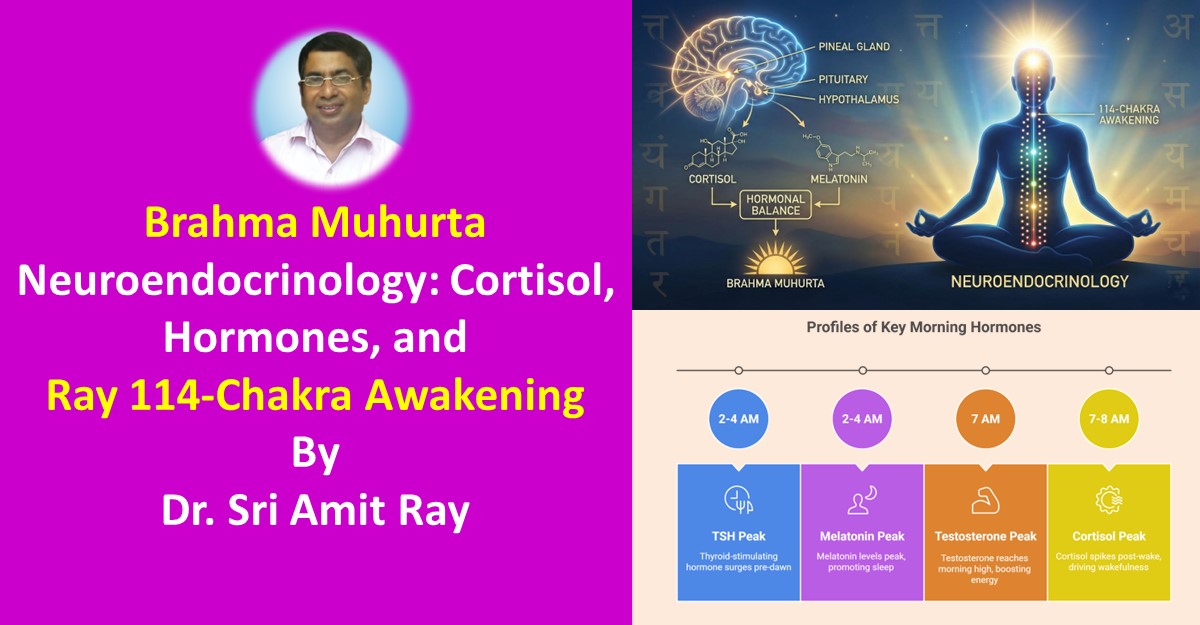
    Brahma Muhurta Neuroendocrinology: Cortisol, Hormones, and 114-Chakra Awakening

    Abstract

    This comprehensive review synthesizes chronobiology, endocrine science, and contemplative practice timing to propose a testable framework linking the pre-dawn endocrine milieu (melatonin decline, circadian cortisol ascent, and the Cortisol Awakening Response) with staged contemplative activation of expanded Sri Amit Ray 114-chakra system. We summarize hormonal timing in the Brahma Muhurta window, discuss interindividual variability in CAR and circadian rhythms, present a translational 48-minute practice protocol, and outline empirical measures (salivary cortisol, melatonin, HRV, and EEG) for validating physiological–phenomenological mappings between endocrine state and multi-stage chakra experiences.

    The Cortisol Awakening Response (CAR), a transient surge in cortisol secretion occurring 30–45 minutes post-awakening, serves as a pivotal regulator of diurnal energy mobilization, cognitive alertness, and stress adaptation [5]. As the highest glucocorticoid pulse, it exemplifies phasic rhythm driving in circadian biology [24]. Rooted in endocrine-circadian interactions, this response aligns temporally with Brahma Muhurta, the pre-dawn period in Ayurvedic tradition, coinciding with shifts in melatonin and serotonin levels [1][24].

    This review elucidates mechanistic intersections: how leveraging CAR during Brahma Muhurta amplifies neuroendocrine benefits, enhances neuroplasticity, and mitigates chronic stress pathologies. Drawing from chronobiology, endocrinology, neuroscience, and Ayurveda, we propose a model where timed meditative interventions modulate hormonal dynamics as zeitgebers or tuners, fostering resilience. Empirical gaps and trials are highlighted, advocating for translational research.

    Keywords: Cortisol Awakening Response, Brahma Muhurta, Circadian Rhythm, Melatonin, Serotonin, Meditation, Ayurveda

    Read more ..


Contact us | About us | Privacy Policy and Terms of Use |

Copyright ©AmitRay.com, 2010-2024, All rights reserved. Not to be reproduced.