
Seven Scientific Benefits of Om Chanting
Here, Sri Amit Ray explains the scientific aspects of om chanting benefits.
Om chanting is a disciplined and flexible process to remove tension, anxiety, fear, depressions, and negativity from life. It can bring positivity to your life like courage, focus, concentration, happiness, and joy, effortlessly. It can improve your state (short term) as well as trait (long term) health, happiness, joy and well-being.
Om chanting is a series of step-by-step process. It is a scientific art but it should be learnt properly to get its benefits. Systematic guided Om chanting can change your emotional reactions and responses to external stimuli and internal experiences in a positive way. It can enhance your efficiency, calmness, tranquility, and mental clarity.
Dr. Ray explains how low frequency Om chanting can reduce our daily stress, strain, anxiety and tensions. Om chanting is effective for stress management. Under various pressure conditions such as before examination, before public speaking, before important sports events and during critical challenges of life Om chanting can enhance confidence and eliminate stress and anxiety. Om chanting improves the connections between the amygdala and prefrontal cortex, which is the key component for relaxation, stress control and better decision making.
Low frequency seven step deep Om chanting increases gamma wave in the brain. The gamma brain waves are known as “feeling of blessings”. The seven step deep Om chanting and meditation is supposed to be practiced for 20 minutes, two times per day. Dopamine, Oxytocin, Serotonin and Endorphins are the four key hormones generated in the body during low frequency Om meditation and these four hormones have huge impact on regulating both state anxiety as well as trait anxiety.
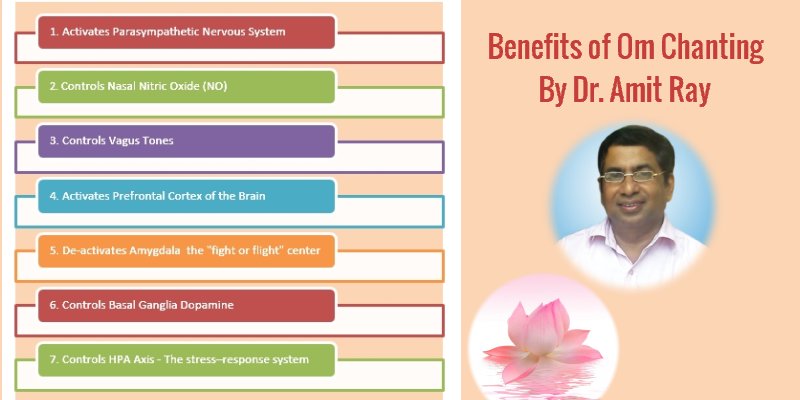
The seven main benefits of Om chanting are as follows:
1. Om Chanting and Parasympathetic Nervous system
The autonomic nervous system has two components, the sympathetic nervous system and the parasympathetic nervous system. The sympathetic nervous system that is affected the most by anxiety, tension, fatigue and depression. The sympathetic nervous system that drives a “fight or flight” response that helps us survive and perform. The parasympathetic wing of our nervous system is the antagonist to the sympathetic in that it helps our body to relax, digest food and heal. People with anxiety are in a state of sympathetic dominance where they are in a near constant state of fight or flight. With the low frequency seven step Om Chanting, parasympathetic nervous system takes over, allowing us to relax and recover from the stressful event.
2. Om Chanting and Nasal Nitric Oxide (NO)
 Nitric oxide (NO), a free radical gaseous molecule has been shown to be involved in diverse healing functions in human body. NO plays vital role in many biological events including regulation of blood flow, platelet function, immunity, and neurotransmission. Within the HPA axis areas, NO is plays a key role in modulating and controlling the release of the stress neurotransmitters. Nitric oxide also plays a key role in DNA damage repair. NO is a highly reactive, short-lived, lipophilic molecule with a half-life of a few seconds, which makes it very difficult to measure it.
Our research group have studied the effect of low frequency seven step Om Chanting on nasal NO. Nasal NO activity has primarily been linked to immunity and anti-inflammatory effects. Bhramari Om Chanting is an effective tool to control nasal NO activities and immunity control.
3. Om Chanting and Vagus Nerve Activation
Vagus nerve is the longest nerve of the autonomic nervous system in the human body. There are two vagus nerves. One vagus nerve on each side of your body, running from your brainstem through your neck to your chest and abdomen. The right and left vagus nerves exit from the brainstem, and they course through the neck, upper chest, lower chest and diaphragm, and into the abdominal cavity. During this course, branches enervate various structures such as the larynx, pharynx, heart, lungs, and gastrointestinal tract. It transmits information to or from the surface of the brain to tissues and organs elsewhere in the body.
Vagus nerve is the information superhighway carrying information from the body to the brain. In the brain, the vagus helps control anxiety and depression. In the gut, it increases stomach acidity, digestive juice secretion, and gut flow. The vagus nerve is connected to your vocal cords and the muscles at the back of your throat. Om chanting, singing Om, humming Om, chanting Om can activate these muscles and stimulate your vagus nerve.
4. Om Chanting and Prefrontal Activation
Human brain is made of an estimated 86 billion nerve cells—called neurons. Neurons communicate with one another through chemical messengers called neurotransmitters. Some neurotransmitters are inhibitory—they try to reduce neuronal functions. Others are excitatory, meaning that they stimulate neuronal function, priming it to send signals to other neurons.
Neurons are organized in clusters that perform specific functions (described as networks or circuits). For example, some networks are involved with thinking, learning, emotions, and memory. Other networks communicate with muscles, stimulating them into action.
The brain has many regions that are interconnected with one another, forming dynamic networks that are responsible for specific functions, such as attention, language, perception, self-regulation, reward, emotion, and movement, stress management along with many other functions.
The three regions that are the key components of networks that are intimately involved in the stress development, elimination and management. They are basal ganglia, the amygdala, and the prefrontal cortex.
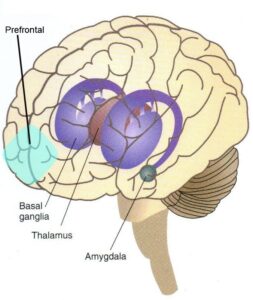
Prefrontal part of the brain region has been associated with creativity, intelligence, leadership, planning complex cognitive behavior, personality expression, decision making, and moderating social behavior.
We found quantitative changes in activation patterns in the prefrontal part of the brain region during our seven step low frequency Om chanting. An increase in oxy-hemoglobin and a decrease in deoxy-hemoglobin were observed during Om chanting in the frontal cortex. Experimental data indicate a role of low frequency Om chanting and Om meditation for the prefrontal cortex in normal sleep physiology, dreaming and deep sleep levels.
5. Om Chanting and Amygdala De-activation
The extended amygdala and its sub-regions, located beneath the basal ganglia, regulate the brain’s reactions to stress-including behavioral responses like “fight or flight” and negative emotions like unease, anxiety, and irritability. This region also interacts with the hypothalamus, an area of the brain that controls activity of multiple hormone-producing glands, such as the pituitary gland at the base of the brain and the adrenal glands at the top of each kidney. These glands, in turn, control reactions to stress and regulate many other bodily processes.
6. Om Chanting and Basal Ganglia Dopamine
Dopamine neurons located in the midbrain (basal ganglia) play a key role in motivation that regulates human behavior. Activation and inactivation of dopamine neurons regulate mood and induce reward and aversion, respectively. High, moderate and low concentrations of dopamine induce euphoric, seeking and aversive mental states, respectively. Experimental data demonstrate that low frequency Om chanting can regulate basal ganglia dopamine, which is involved in emotional reactions and responses.
Basal ganglia is the main area for controlling dopamine. the key hormone for stress management. Basal ganglia is located near the center of the brain. This is strongly interconnected with the cerebral cortex, thalamus, and brainstem, as well as several other brain areas. The basal ganglia are associated with a variety of roles such as motor learning, executive functions and behavior, and emotions. The main function of Basal ganglia is reward processing and building habit patterns.
7. Om Chanting for Better Hormonal Balance
Low frequency systematic Om chanting releases immense healing energy from your subconscious mind. Your subconscious regulates and controls your bodily functions. Proper Om chanting can balance your hormones and enables you tap your body’s natural healing ability to regulate and repair itself, as it improves your mental states, and your psychological and physical well being. The main hormones associated with meditations are: Dopamine, Oxytocin, Serotonin, GABA and Endorphins.
Dopamine stimulates ‘reward circuit’ by triggering an intense sprint of happiness. Oxytocin is a powerful hormone released during deep Om meditation. It develops feelings of attachment towards the object of attention. Vasopressin is another vital hormone in the long-term commitment towards the Om meditation. Vasopressin is released at the later part of the meditation. Serotonin is known as the well-being chemical. It is important for the feeling of happiness. The pleasant experiences of serotonin have a calming influence throughout the body. Endorphins are responsible for developing high-feelings of euphoria. If there is pain in the body due to long sitting posture, endorphins are released which gives a pleasant feelings.
OM Inner Science Meditation Protocols
OM Inner Science Meditation is a structured and research-informed system of OM chanting and deep meditation designed for stress reduction, emotional balance, cognitive wellbeing, and spiritual awakening. It blends ancient mantra wisdom with modern neuroscience to help practitioners shift from scattered mental activity to coherent brain–heart harmony.
The system unfolds in two transformative phases:
Om Mantra Initiation – Energy Transmission
In this phase, practitioners receive the foundational vibration of OM through a guided energetic transmission. This process attunes the subtle body to the correct frequency of the mantra, opens the internal pathways for resonance, and prepares the mind–body system for deeper states of awareness. It establishes the inner connection that allows OM to work effectively at neural, emotional, and spiritual levels. This phase is very crucial, because in this phase the master decided the person specific exact sequence, gaps, durations, and other finer parameters of om chanting.
By the end of this initiation, the practitioner carries within them the correct vibrational signature of OM, forming a stable and lifelong foundation for deeper meditation practices.
Om Mantra Guided Meditations
After initiation, practitioners move into a series of guided OM meditations. These sessions progressively refine breath, sound, attention, and inner posture. The practices help stabilize the mind, regulate the autonomic nervous system, enhance vagal tone, improve focus, and awaken deeper intuitive states. Over time, the guided meditations lead the practitioner from audible chanting to subtle mental chanting, and finally to the stillness of silent OM—where profound clarity and inner peace naturally arise.
Together, these two phases form a complete inner science framework that supports long-term wellbeing and transformative spiritual growth.
Online Om Chanting and Meditation:
If you are interested in Online OM Meditation you can register here. This online Deep Om meditation of Dr. Ray are typically 45 mins to 60 mins long, each session. There are three sessions. Each online session is held on individual basis, based on mutually agreed date and time depending on your specific needs.
During the online meditation session, you will have a chance for guided Om meditation and will be able to discuss meditation and meditation techniques as well as being given appropriate meditation guidance, advice and mentoring. People of all ages and all walks of life can attend this online deep OM meditation class.

Practices and Future Directions
Near infrared spectroscopy (NIRS) is an optical technique with high temporal resolution and reasonably good spatial resolution, which allows noninvasive measurement of the blood oxygenation of various tissues. The current work is focused in assessing and correlating brain activation, connectivity and cortical lateralization of the frontal cortex in response to Om chanting, using NIRS.
Om chanting is an ancient scientific art but it should be learnt properly to get its benefits. Om chanting is not simple. It is a series of step-by-step process. We observed low frequency Om chanting reduces both trait (long-term) anxiety and state (short-term) anxiety. Om chanting improves the connections between the amygdala and prefrontal cortex. It is key to stress control.
However, more longitudinal, randomized, and actively controlled studies with larger sample sizes are necessary to deepen our scientific understanding of Om meditation and Om chanting of how people with different personality traits changes their behavior positively with the practice of deep Om meditation.
Om chanting is a series of step-by-step process. It is a scientific art but it should be learnt properly to get its benefits. Systematic guided Om chanting can change your emotional reactions and responses to external stimuli and internal experiences in a positive way. It can enhance your efficiency, calmness, tranquility, and mental clarity.
Conclusion
OM chanting offers a powerful blend of ancient wisdom and modern neuroscience, making it one of the most effective tools for mental, emotional, and physiological wellbeing. Scientific studies show that chanting OM regulates the nervous system, enhances cognitive functions, and promotes inner calm. It increases theta–alpha brainwave coherence, creating deep relaxation and improved attention.
The M-sound vibration stimulates vagal pathways, which boosts vagal tone, helping to reduce stress, anxiety, and emotional reactivity. OM chanting also activates the prefrontal cortex, the brain’s center for compassion, clarity, and self-control. The resonance of OM naturally quiets the limbic system, lowering fear and overthinking, while improving emotional regulation. Research further demonstrates that OM chanting enhances heart-rate variability (HRV), a key indicator of resilience, cardiovascular balance, and overall wellbeing. Additionally, OM increases GABA levels, the brain’s primary calming neurotransmitter, supporting better sleep and reduced tension.
Together, these seven scientific benefits confirm that OM is more than a sacred sound—it is a holistic neurophysiological practice that harmonizes the mind, strengthens the body, and elevates consciousness.
References:
- Ray, Amit. OM Chanting and Meditation. Inner Light Publishers, 2010.
- Ray, Amit. OM Sutra: The Pathway to Enlightenment. Inner Light Publishers, 2012.
- Ray, Amit. Neuroscience of OM Chanting vs AUM Chanting: A Comparative Analysis. Inner Light Publishers.
- Ray, Amit. "Seven Scientific Benefits of Om Chanting." Yoga and Ayurveda Research, 1.3 (2019): 42-44. https://amitray.com/seven-scientific-benefits-of-om-chanting/.
- Ray, Amit. "Heart Rate Variability with Om Meditation and Chanting." Compassionate AI, 3.9 (2019): 72-74. https://amitray.com/stress-relief-and-heart-rate-variability-with-om-meditation/.
- Ray, Amit. "The Power of 24 Healing Chakras in Your Hand." Yoga and Ayurveda Research, 3.7 (2020): 60-62. https://amitray.com/the-24-healing-chakras-in-your-hand/.
- Ray, Amit. "Reticular Activating System for Manifestation and Visualization and 114 Chakras." , 1.5 (2021): 3-5. https://amitray.com/reticular-activating-system-for-manifestation/.
- Ray, Amit. "The Sama Veda Mantra Chanting: Melody and Rhythms." Yoga and Ayurveda Research, 4.12 (2023): 30-32. https://amitray.com/the-sama-veda-mantra-chanting-melody-and-rhythms/.
- Ray, Amit. "Glymphatic System Brain Health and 40 Hz Music and Mantra Chanting." Yoga and Ayurveda Research, 3.8 (2024): 21-23. https://amitray.com/glymphatic-system-brain-health-and-40-hz-music-and-mantra-chanting/.
- Ray, Amit. "Benefits and Neuroscience of Ek-Sruti Mantra Chanting." Yoga and Ayurveda Research, 3.9 (2024): 90-92. https://amitray.com/benefits-and-neuroscience-of-ek-sruti-mantra-chanting/.
- Ray, Amit. "Neuroscience of Hanuman Chalisa and The Ray 114 Chakras for Healing." Yoga and Ayurveda Research, 4.11 (2025): 48-50. https://amitray.com/neuroscience-of-hanuman-chalisa/.
- Ray, Amit. "Gayatri Mantra Research: A Comprehensive Scientific Review (2025)." Yoga and Ayurveda Research, 4.12 (2025): 12-14. https://amitray.com/gayatri-mantra-research-review/.
- Ray, Amit. "Sanskrit Mantra Chanting Styles, Benefits, Chakras, and Deeper Meanings: A Complete Guide." Yoga and Ayurveda Research, 4.12 (2025): 30-32. https://amitray.com/sanskrit-mantra-chanting-styles-benefits-and-chakras/.