
Makar Sankranti the 14th January is considered as the beginning of an auspicious phase or the holy phase of transition marking the end of an inauspicious phase. It is regarded as a significant day for spiritual practices. It is the day of activating the Saubhagya Chakra, the chakra of prosperity and wealth. There are 114 chakras and 72000 nadis in the human body. These chakras are linked with the seasons, the sun and the moon movements. The January, 14th is very important for awakening the chakras and the nadis.
Makar Sankranti and the Holy River Ganga
It is believed that taking a dip in holy rivers on Sankranti day result in merit or absolution of past sins. The holy river ganga is flowing in our body and mind as an energy channel (nadi). Alternatively, taking dip in holy river Ganges means a kind of special meditation – the inner pilgrimage into the divine energy channels connected with the Higher Consciousness.
In the mythological story on this special day of Makara Sankranti the souls of the 60,000 sons of King Sagara were released from patala, (physically below the earth). Mentally, it is the symbolic day of getting release from the subconscious mind patterns of birth and death cycles. The 60,000 sons of king Sagara are associated with the 60,000 nadis in the body, which carries the unconscious and subconscious habit patterns of the body and mind.
It is also believed that those who worship Lord Surya on Sankranti are blessed with success and prosperity, and accordingly, people take a holy dip in rivers, especially Ganga, Yamuna, Godavari, Krishna and Kaveri. The Goddess wealth, Lakshmi is usually worshiped on the day of Sankranti. The day for the gods, the positive energy, and the night for the demons will start from this day.
Makar Sankranti Date and Time
Makar Sankranti is expected to fall on January 14, with the auspicious timing (Punya Kaal) starting in the morning. This harvest festival is celebrated with kite flying, feasts, and rituals across India and neighboring regions. It marks the Sun’s northward movement (Uttarayana) and the end of the winter solstice. The exact timing of the festival is determined by the Sun’s entry into Makara Rashi, as per the Hindu calendar.
Gangasagar Mela and Sage Kapil Muni
Makar Sankranti, celebrated on January 14, holds profound mythological and spiritual significance, deeply intertwined with the ancient legend of King Sagara. According to Hindu scriptures, King Sagara’s 60,000 sons were cursed and reduced to ashes in the netherworld (Patala) after disturbing Sage Kapil Muni. Their souls remained trapped until King Bhagiratha, Sagara’s descendant, performed intense penance to bring the divine Ganga from the heavens to earth. On the auspicious day of Makar Sankranti, Ganga’s sacred waters finally touched their ashes at the confluence now known as Gangasagar, liberating their souls and granting them moksha. This event symbolizes physical purification below the earth and, on a deeper level, release from the subconscious cycles of birth and death.
This sacred confluence at Sagar Island in West Bengal is the site of the annual Gangasagar Mela, one of India’s largest pilgrimages after the Kumbh Mela. Held around Makar Sankranti, the mela attracts millions of devotees who gather for a holy dip (Sankranti Snan) where the Ganga meets the Bay of Bengal, believing it washes away sins and leads to spiritual liberation. Pilgrims offer prayers at the Kapil Muni Temple, perform rituals, and seek blessings for prosperity and enlightenment. The fair embodies faith, devotion, and renewal, marking the Sun’s transition into Capricorn and the onset of longer days, making it a powerful occasion for inner awakening and detoxification of the mind and body.
Detoxification of the Subconscious Mind
In the tradition of Sri Amit Ray, 72000 Nadi system, the 60,000 sons are metaphorically linked to the 60,000 nadis (energy channels) in the human body that carry unconscious habit patterns.
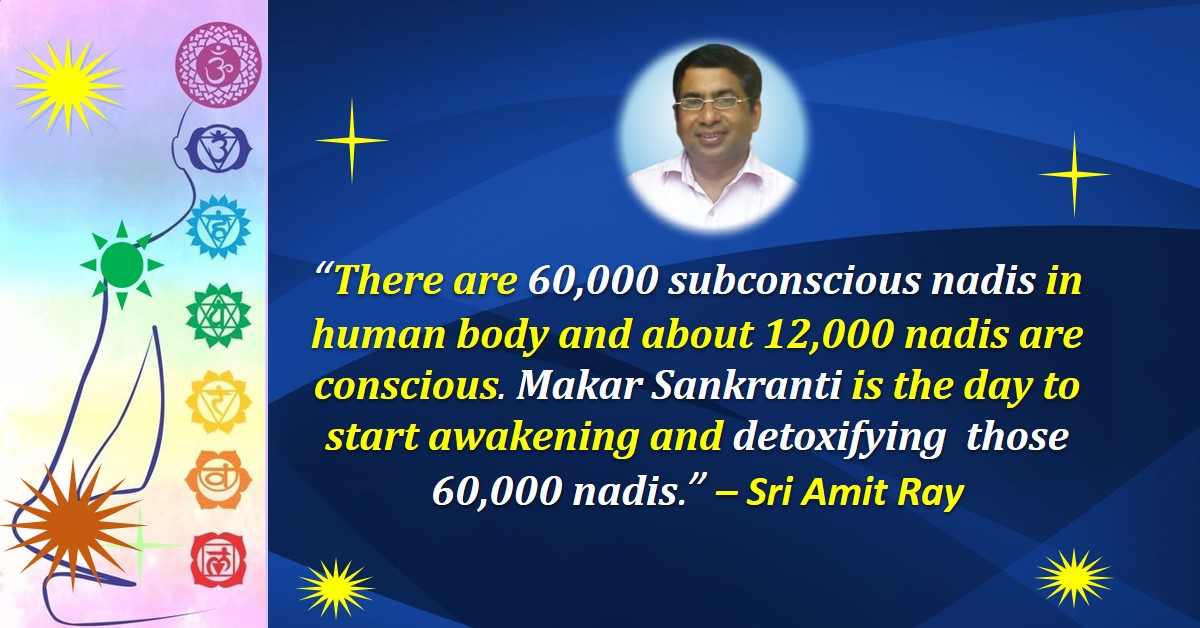
Of these, he distinguishes approximately 60,000 as subconscious nadis, which harbor deep-seated unconscious and subconscious habit patterns, karmic imprints, and cycles of birth and death. The remaining about 12,000 are conscious nadis, more aligned with awake awareness, voluntary actions, and higher cognition. This classification builds on ancient yogic wisdom while offering a modern interpretive framework, linking the nadis to both neurological pathways and quantum-like energy flows.
“On Makar Sankranti, as the Sun begins its sacred northward journey, awaken the 60,000 subconscious nadis within—detoxify the hidden patterns of the soul and step into the light of true liberation.” – Sri Amit Ray
Makar Sankranti, marking the Sun’s transition into Capricorn and the onset of Uttarayan (the auspicious northward phase), is highlighted by Sri Amit Ray as an ideal cosmic window to initiate the awakening and detoxification of these 60,000 subconscious nadis. Just as the mythological liberation of King Sagara’s 60,000 sons by the Ganga symbolizes release from lower realms, this festival represents an inner opportunity for profound purification—clearing blockages in the subconscious channels through meditation, pranayama, and mindful rituals.
Rituals
The festival signifies the Sun’s northward journey, symbolizing enlightenment, new beginnings, and prosperity. The Sun’s alignment with Capricorn fosters balanced energies for growth and renewal. Old items are burned in bonfires, symbolizing the removal of negativity.
Devotees take a holy dip in rivers like the Narmada and Shipra to cleanse sins and invite positive energy. Villages and towns host melas (fairs) with cultural performances, folk dances, and local delicacies.
People celebrate by preparing traditional sweets made of sesame (til) and jaggery (gur), symbolizing warmth and friendship. Families decorate their homes with rangoli (muggu) and share sweets.
Makar Sankranti and the Lunar Calendar
In India, from ancient times to the present day, six seasons or Ritus. In India, we follow a lunar calendar; the moon goes from new moon to new moon or full moon to full moon in 29.5 days. We get 12 full moons in 354 days, making a lunar calendar year 354 days long. However, the Sun returns to the same spot in the sky every 365.25 days. So, there is a difference of 11.25 days between the solar and lunar years. Every 2.5 years, therefore, an extra month is added to the lunar calendar to roughly synchronize the two.
The path of the sun is divided into 27 nakshatras or sectors while the path of the sun is also divided into 12 Rashis or Signs. The 360 degrees of the sky is divided into 27 subdivisions of 13.20 degrees identified with 27 stars. These Nakshatras are broadly classified under the three heads of Deva (divine), Nara (human) and Rakshasa (Demonic).
Each Rashi is assigned to particular Nakshatra(s). Nakshatras are used for determining the auspicious dates and Muhurtha (moment). Makar Sankranti is a significant and auspicious day as the Sun enters Makar Rashi. Makar Rashi is linked to the Yashasvini Nadi the channel of leadership and the Vajra Nadi – the path of manifestation.

Kumbh Mela and Makar Sankranti
The January 14 is celebrated as New Year’s Day by religious groups who use the Julian calendar. It is celebrated on a fixed calendric day of the solar calendar. It is believed that if one die during Makar Sankranti, they are not reborn but go directly to heaven. Makar Sankranti generally marks the beginning of the Kumbh Mela, the largest religious gathering in the world, is held every 12 years in rotation at the four holy places.
Makara Sankranti, also known as Maghi or Sankranthi, is a Hindu festival dedicated to Lord Surya. The festival of Makar Sankranti is celebrated every year in the lunar month of Magha (January). It also marks the first day of the sun’s transit into Makara Rashi (Capricorn), marking the end of the month with the winter solstice and the start of longer days. Bathing in the early hours on Makar Sankranti is important. Hindus light lamps with sesame oil as this is supposed to give prosperity and drive away all sins.
Makar Sankranti Festivals
This is the time of the famous ganga sagar mela, where more than four million people gather on the banks of the Ganga at the Gangasagar, to take a holy dip in Ganges.
The festival of Makar Sankranti is known with different names in different parts of the country, for example, Magh Bihu in Assam, Maghi (preceded by Lohri) in Punjab, Haryana and Himachal Pradesh, popular amongst both the Hindus and Sikhs in central India.
Thai Pongal in Tamil Nadu, Ghughuti in Uttarakhand Makara Sankranti in Odisha, Karnataka, Maharashtra, Goa, West Bengal (also called Poush Sankranti) and Uttar Pradesh (also called Khichdi Sankranti) or simply as Sankranthi in Andhra Pradesh (also called as Pedhha Panduga) and Telangana.
Across India, Makar Sankranti is celebrated with diverse customs:
- Andhra Pradesh: Bhogi, Makar Sankranti, Kanuma, and Mukkanuma.
- West Bengal: Known as Poush Sankranti, it involves traditional fairs and rituals.
- Tamil Nadu: Celebrated as Thai Pongal, a harvest festival expressing gratitude to the Sun God.
- Assam: Observed as Magh Bihu, marking the end of the harvesting season.
- Punjab: Known as Maghi, following the festival of Lohri, with traditional dances and feasts.
- Gujarat: Celebrated as Uttarayan, famous for its vibrant kite-flying tradition.
Makar Sankranti and Uttarayan
On January 14 Uttarayan period (Makar Sankranti) starts and ends at Karka Sankaranti that is 16 July. Uttarayan refers to the northward movement of the Sun. It is six months long period. During Uttarayan days are longer and nights are shorter. This period is also known as the period of devas – the divine positive energies. Meditations, donations, charities, spiritual practices are very effective during this period. During Makar Sankranti the sun rays are very healthy for the body and skin. This northward movement of the Sun from winter to summer solstice consists of three seasons: winters, spring and summers.
Makar Sankranti and the Nature
The season begins to change from winter to slow and gradual shift towards equinox and then summer, days will start gradually to be longer than the nights. This is the time when trees will start budding, and plants are beginning a new cycle of growth. In many places, spring flowers are beginning to bloom. Scientifically there will be changing sensitivity of the hypothalamic-pituitary axis to gonadal hormones, which reduces the stress, strain and anxiety. Hence, this period is best time to transform the raw energies to subtle higher spiritual energies.
Summary
Makar Sankranti the 14th January of every year is regarded as the beginning of an auspicious phase for humanity. This northward movement of the Sun from winter to summer is an ideal period for meditation, spiritual and virtues activities. Makar Sankarni is the ideal period for detoxifying the 60,000 nadis, the energy channels in the body through meditation. Activation of the Saubhagya Chakra is like taking dip in the river Ganges.
72000 Nadis Training Course
The course cover the 14 principal nadis and other 114 main nadis in the human body. These nadis are densely connected to the 114 chakra system.
Makar Sankranti 2026 FAQ
1. When is Makar Sankranti in 2026?
Makar Sankranti 2026 will be celebrated on Wednesday, January 14, 2026, across most of India. The exact astronomical transition (Sun entering Capricorn) may vary slightly by timezone, but the festival is observed on January 14.
2. What is the significance of Makar Sankranti?
It marks the Sun’s transit into Capricorn (Makara rashi), signaling the end of winter and the beginning of longer days (Uttarayana). It is a harvest festival expressing gratitude to nature and the Sun God for prosperity.
3. Why is Makar Sankranti celebrated on a fixed date unlike other Hindu festivals?
It follows the solar calendar, based on the Sun’s movement into Capricorn, so it almost always falls on January 14 (or rarely 15), unlike lunar-based festivals.
4. What are the common names for this festival in different regions of India?
Known as Uttarayan in Gujarat, Pongal in Tamil Nadu, Magh Bihu in Assam, Maghi in Punjab/Haryana, and simply Makar Sankranti in most of the other states.
5. Why is kite flying a major tradition during Makar Sankranti?
Especially in Gujarat (Uttarayan), kite flying symbolizes reaching towards the Sun and enjoying the brighter days. The sky fills with colorful kites, and friendly competitions are common.
6. What foods are traditionally prepared for Makar Sankranti?
Sweets made from sesame seeds (til) and jaggery (gul), like tilgul laddoo, are popular as they provide warmth in winter. Other dishes include khichdi, pongal, and regional harvest foods.
7. What is the meaning behind exchanging tilgul sweets?
In Maharashtra, people exchange tilgul saying “Tilgul ghya, god god bola” – meaning “Take this sweet and speak sweetly,” promoting kindness and harmony.
8. Why do people take holy dips during the festival?
Taking a bath in holy rivers like the Ganga is believed to wash away sins and bring merit. Famous spots include Gangasagar in West Bengal.
9. How is Pongal celebrated in Tamil Nadu?
Pongal is a four-day festival starting around Makar Sankranti, involving cooking sweet pongal rice, drawing kolam (rangoli), and honoring cattle and the harvest.
10. Is charity important during Makar Sankranti?
Yes, donating food, clothes, sesame, and jaggery to the needy is considered highly auspicious, earning good karma during this transition period.
11. What is the mythological importance of Uttarayana?
In the Mahabharata, Bhishma waited on his bed of arrows to leave his body during Uttarayana, as dying in this period is believed to lead to liberation.
12. How can one wish someone on Makar Sankranti 2026?
Common greetings include “Happy Makar Sankranti!”, “Happy Uttarayan!”, “Happy Pongal!”, or in Marathi “Tilgul ghya ani god god bola!” Wish for prosperity, joy, and warmth.